Outdoor Cat Enclosure: Seal the Escape Vectors Before You Choose the Material
An outdoor enclosure rarely fails because the cat is a genius. It fails at a seam, a corner, a latch or a sagging panel — and then the mesh rusts through at a cut edge years before the frame gives up. Both problems are decided by numbers you can check on a drawing, before anything is welded.
Four ways out, and only one of them is the wall
Buyers picture an escape as a cat going over the fence. In practice the exits we see described most often are, in order: through a gap at a junction, under a corner, out of a gate that was never properly latched, and only then over the top. That matters commercially because the first three cost almost nothing to design out, and the fourth is the one that sells roof panels.
| Vector | What to measure | Spec that holds | How it fails |
|---|---|---|---|
| Over the top | Footholds (rails, hinges, cross-braces, sagging mesh) in the top 90 cm | Roof panel, or an inward overhang of 40 cm or more at 45° | Mesh is a ladder; a healthy adult cat can clear roughly 1.5 m from a standstill and climb the rest |
| Under the edge | Depth of the buried skirt or apron at every corner | 30 cm apron turned outward, or mesh buried 30–40 cm | A cat digs at the corner where the frame is weakest and the soil is loosest |
| Through the mesh | Aperture size and wire diameter; mesh sag between fixings | Aperture ≤ 25 × 25 mm, wire ≥ 1.6 mm, sag under 20 mm | 50 mm mesh passes a kitten; sagging mesh becomes a step |
| Gate and latch | Gap at the hinge side, latch type, spring return | Two-stage or spring-loaded latch; gap ≤ 10 mm | A barrel bolt vibrates open, or the frame racks and the gap opens to 30 mm |
| Junctions | Fixing pitch along every panel edge | Fixings at ≤ 300 mm centres with washers | Wind racking opens a corner gap that no single fixing can close again |
Two of those numbers deserve a sentence each, because they are the ones buyers get wrong. Aperture: an adult cat's head is roughly 5.5–7 cm wide, so a 25 mm aperture is comfortably small enough to stop a head passing while keeping the enclosure open to air and light. Go to 13 mm if the unit will ever hold kittens — not for strength, but because a 25 mm square will take a kitten's shoulder and then hold it. Height: height alone is not a containment specification. A 1.8 m fence with a climbable mesh face and no roof is an invitation; the same fence with a 40 cm inward overhang is a boundary. If the customer refuses a full roof, the overhang is the compromise that actually works, and it must be solid or tightly tensioned — a loose net overhang is a foothold with extra steps.
Wind: the mesh is not the sail, the roof and the windbreak panels are
This is the calculation that decides whether the thing is still standing after its first autumn, and it is simple enough to do on the back of an order sheet. Dynamic pressure rises with the square of wind speed:
q = 0.6125 × v² (N/m², with v in m/s, at sea level and about 15 °C)
| Gust | Dynamic pressure | Force on 2 m² of solid panel | Force on 4 m² (a typical roof) |
|---|---|---|---|
| 15 m/s (54 km/h) | 138 Pa | 276 N ≈ 28 kgf | 552 N ≈ 56 kgf |
| 20 m/s (72 km/h) | 245 Pa | 490 N ≈ 50 kgf | 980 N ≈ 100 kgf |
| 25 m/s (90 km/h) | 383 Pa | 766 N ≈ 78 kgf | 1,532 N ≈ 156 kgf |
| 30 m/s (108 km/h) | 551 Pa | 1,102 N ≈ 112 kgf | 2,204 N ≈ 225 kgf |
| 35 m/s (126 km/h) | 750 Pa | 1,501 N ≈ 153 kgf | 3,001 N ≈ 306 kgf |
Note what the table does not say. An open mesh wall at 50% porosity does not behave like a solid panel — most of the flow passes through and the load is a fraction of the figure above. The load is carried by the solid parts: the roof, any windbreak or privacy panel, the solid lower skirt that stops digging, and the sign the retailer bolts to the front. A 2 × 2 m enclosure with a solid roof therefore has roughly 4 m² of uplift area acting on four post bases, and at 25 m/s that is on the order of 150 kgf trying to lift it. Sandbags and a paved slab are not an anchorage. What holds is a mechanical fixing into concrete, or posts set at least 60 cm into the ground in a concrete collar — and the fasteners, not the posts, are usually the weak link.
We have deliberately left out pressure coefficients, gust factors and terrain categories: those belong to a structural engineer working to a local code. The table above is arithmetic on the stated area, and it is enough to tell you whether a design is in the right order of magnitude or an order out.
Material life is set by coating mass, not by the word "galvanised"
Two mesh panels can both be sold as galvanised and differ by a factor of four in how long they last, because what matters is grams of zinc per square metre — and the number is almost never printed. The published ISO 9223 corrosivity bands give first-year zinc loss rates that let you convert coating mass into years:
| Zinc coating | Approx. thickness | C3 (sheltered urban) | C4 (coastal, industrial) | C5 (marine splash) |
|---|---|---|---|---|
| 60 g/m² (typical welded mesh) | ≈ 8 µm | ≈ 6 years | ≈ 3 years | ≈ 1–2 years |
| 120 g/m² | ≈ 17 µm | ≈ 12 years | ≈ 5–6 years | ≈ 3 years |
| 240 g/m² (hot-dip after welding) | ≈ 34 µm | ≈ 24 years | ≈ 11 years | ≈ 5 years |
| 275 g/m² (heavy hot-dip) | ≈ 38 µm | ≈ 27 years | ≈ 12–13 years | ≈ 6 years |
The years are the coating mass divided by the mid-point of the published first-year rate band for that category (10, 22 and 45 g/m²/year). Real life is kinder in the middle years because the zinc builds a protective layer and the rate falls, and harsher at cut ends and welds, where there is no coating at all. Treat the table as a comparison tool: it tells you why a 60 g/m² mesh in a coastal garden is a two-season product and a 240 g/m² mesh in the same garden is a five-year one.
Three details decide which side of that table you land on, and all three are visible in a sample:
- Cut edges and welds. Coating is applied before cutting in most welded-mesh lines, so every cut end is bare steel. Hot-dip after fabrication closes this; if it is not done, ask for the cut ends to be capped or painted, or the rust will start at the bottom rail within a season and travel.
- PVC coating over thin zinc. A plastic sleeve looks like the premium option and often is not: water gets in at the cut ends, sits against the zinc, and the steel corrodes under the plastic where you cannot see it. On a coastal site, a visible PVC split is usually the second symptom, not the first.
- Dissimilar metals. Stainless fixings into galvanised steel are fine; copper, brass or lead flashing in contact with galvanised mesh is not, and the corrosion is fast and localised. Specify the fastener material with the frame, not after.
The frame has its own vocabulary. For timber, "pressure treated" means nothing on its own — the specification is a use class: UC3 for above-ground members exposed to weather, UC4 for anything in ground contact. Posts set into soil are UC4 or they are a five-year post. Better still, keep timber out of the ground entirely: a galvanised post base on a concrete pad removes the question. Aluminium frames avoid the corrosion argument but need a wall thickness and grade stated, because thin-wall tube dents at the post base where the load concentrates.
What this does to a flat-pack carton
This is where an outdoor range becomes a different business from an indoor one, and it is the part that surprises importers. The enclosure is mostly air, but it is not mostly air in the carton. A 2 × 2 × 1.8 m unit needs roughly 14.4 m² of mesh (8 m of perimeter × 1.8 m of height) plus a frame, and how that is packed changes the freight more than the design does:
- Rolls versus welded panels. Mesh on a roll compresses well but arrives needing tensioning on site, which turns a two-hour assembly into a day and generates the "it sags" complaint. Pre-welded panels ship flat and assemble fast, but the longest panel sets the carton length — a 1.95 m panel means a carton over 2 m, which is the difference between a parcel rate and a freight rate in most markets.
- Panel count is the real cost driver. Eight small panels need more frame, more fixings and more assembly minutes than four large ones, and the fixing count is what customers complain about at 9 p.m. with a hex key.
- Volumetric weight, not mass. A carton of panels weighs far less than the space it occupies, so carriers bill the volume. Confirm the carton dimensions before you price the landed cost, because a 10 cm increase in carton height on a 2 m long box can add more to the freight than the mesh costs.
None of that is an argument against the product. It is an argument for fixing the panel layout, the carton and the fixing count at the sample stage, where changes are free, rather than after the first container, where they are not.
What to put on the purchase order
- Containment spec — roof or 40 cm inward overhang, 30 cm ground apron, mesh aperture and wire diameter, gate latch type. Written, not implied.
- Coating mass in g/m², and whether the mesh is hot-dipped after fabrication. If the supplier cannot state the number, that is the answer.
- Fastener material and fixing pitch, in the same document as the frame spec.
- Timber use class (UC3 / UC4) or a metal frame with grade and wall thickness.
- Anchorage — what the unit is fixed to, and the hardware supplied for it. Sandbags are not anchorage.
- Wind assumption — the gust speed the design is intended for, stated plainly, so the customer knows what it is and is not rated for.
- Carton dimensions and panel count, confirmed before the loading plan is fixed.
From our product catalogue
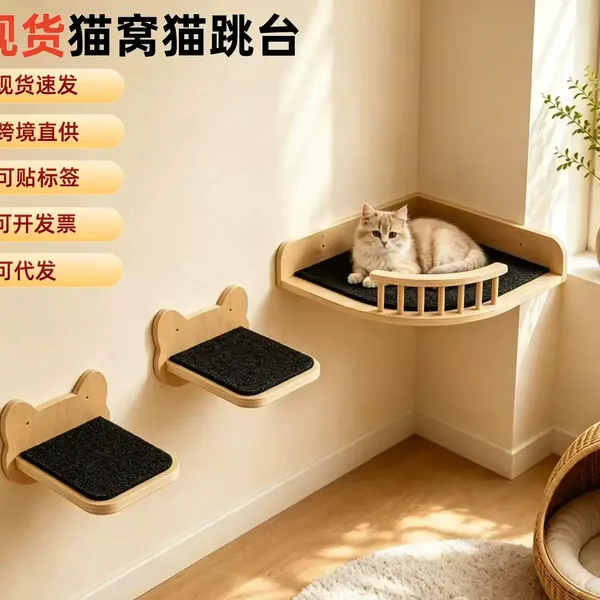
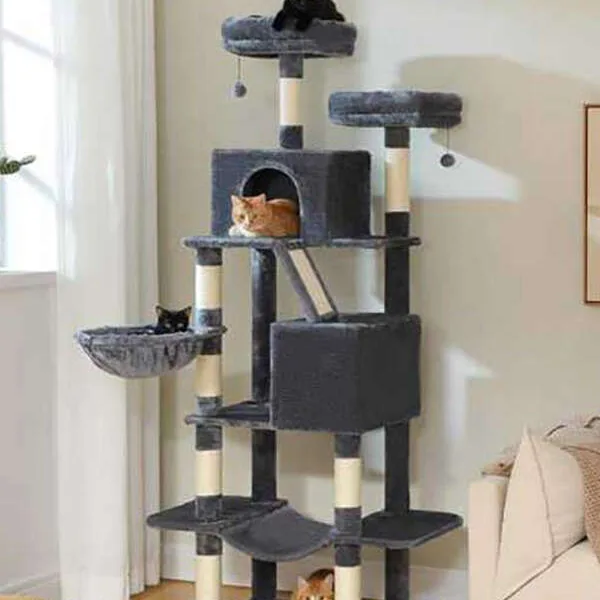
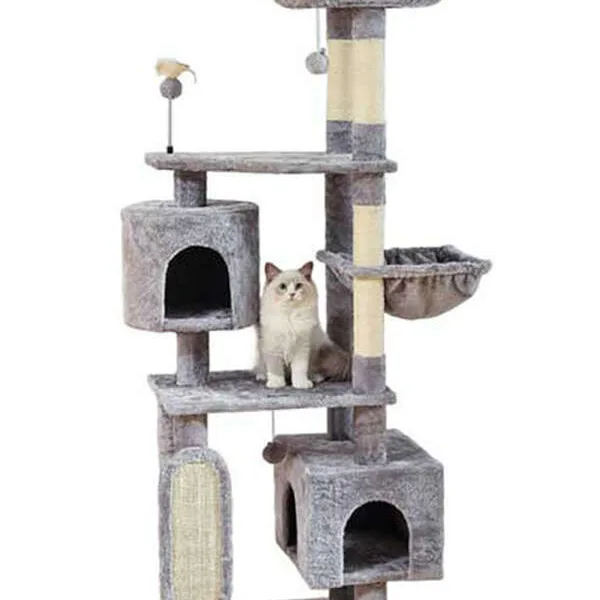
Real products we manufacture — sizes and options are on the product page.
Buying checklist
- Walk the four escape vectors in order — junction, ground edge, gate, top — before discussing height
- Mesh aperture ≤ 25 × 25 mm with wire ≥ 1.6 mm; 13 mm if kittens will ever use it
- Roof, or an inward overhang of 40 cm at 45°, and no footholds in the top 90 cm
- Ground apron 30 cm outward or mesh buried 30–40 cm at every corner
- Coating mass in g/m², hot-dipped after fabrication, and stainless fixings at ≤ 300 mm pitch
- Check the wind arithmetic for the actual solid area — roof and windbreak panels, not the mesh — then specify the anchorage
- Confirm panel count and carton dimensions before pricing freight; the longest panel sets the carton length
FAQ
Can a cat climb out of an enclosure if the mesh is strong enough?
Strength is not the issue — grip is. Welded mesh, chain link and even taut netting all give a cat something to hook its claws into, and a healthy adult can jump roughly 1.5 m from a standstill before it starts climbing. That is why the top of the run matters more than the bottom: clear the top 90 cm of rails, braces, hinges and sagging mesh, and either roof the unit or turn the top 40 cm inward at 45°. The overhang works because the cat cannot reach past it and hang on — it has to let go to get around it, which they generally will not do. A roof is the only version that also keeps other animals out, which is a separate reason buyers choose it.
What mesh size keeps a kitten in without making the enclosure dark?
For kittens, 13 mm aperture is the practical choice: a 25 mm square will admit a kitten's shoulder and then trap it, which is a worse outcome than an escape. Wire diameter matters as much as aperture — 1.0 mm mesh deforms and sags under a climbing cat, and sag is what turns a wall into a ladder — so specify 1.6 mm or heavier even at 13 mm aperture. Light loss is less than people expect: at 13 mm aperture with 1.6 mm wire, something like 20–25% of the surface is metal, so the enclosure still reads as open. If the customer wants more light, increase the panel size and reduce the frame, not the wire.
What rusts first on a galvanised enclosure, and how do I specify against it?
The cut ends and the welds, because most welded mesh is galvanised before it is cut and every cut edge is bare steel. After that it is the bottom rail, where soil, splash and standing water keep the surface wet longest. The specification that fixes it is coating mass in grams per square metre plus hot-dip galvanising after fabrication — 60 g/m² is a three-year product on a coastal site, 240 g/m² or more is a five-to-ten-year one. Then keep dissimilar metals apart: stainless fixings against galvanised steel are fine, copper or brass in contact with it are not. If the frame is timber, ask for the use class rather than the phrase 'pressure treated' — UC3 above ground, UC4 in ground contact, or keep the posts out of the soil on galvanised bases.
Sourcing an outdoor range alongside your indoor cat furniture?
Send us the panel sizes, the market and the wind assumption, and we will tell you plainly which parts of the range our factory can quote today and which it cannot — with panel dimensions, board and frame grades, fixing counts and carton data, so the freight maths and the containment spec are settled before the first container rather than after it.
See the rangeFloor to Ceiling Cat Tree: What to Check Before You BuyWall Mounted Cat Shelves: Load Ratings, Fixings and LayoutCat Tree for a Maine Coon: Sizing Rules That Actually WorkCat Tree for Multiple Cats: Sizing for Two, Three or MoreSisal Cat Tree Posts: What Actually Determines How Long They LastHow Tall Should a Cat Tree Be? A Practical Guide