Floor to Ceiling Cat Tree: What to Check Before You Buy
A tension-mounted tower gives a cat vertical territory without taking floor space. It also puts the entire load on your ceiling — which is the part most cheap models get wrong.
How the tension mount actually works
The pole is slightly longer than the floor-to-ceiling gap. A threaded foot at the top compresses a spring, and that compression holds the tower upright. No drilling, no wall damage. The cat's weight is not carried by the pole sitting on the floor — it is carried by friction against the ceiling.
That single sentence explains most failures. If the ceiling is weak (suspended ceiling tiles, plasterboard without a joist, acoustic panels), there is nothing for the pole to push against, and the tower will lean the first time a large cat jumps onto the top platform.
Ceiling types, and what each one needs
| Ceiling | Verdict | What to do |
|---|---|---|
| Concrete / solid slab | Best case | Standard tension foot is enough; add a rubber pad to avoid marks |
| Plasterboard on timber joists | Works, if you hit a joist | Position the pole under a joist, or add a load-spreading plate |
| Suspended / drop ceiling | Not suitable | Do not sell it into this use case — recommend wall-mounted instead |
| Sloped or vaulted | Needs a swivel foot | Use a pivoting top plate rated for the angle |
Height range and why it matters
Typical adjustable ranges run from about 230 cm to 290 cm, with extensions for rooms taller than that. Two things to check:
- Overlap at the low end. A pole that only just reaches 230 cm in a 230 cm room has almost no spring compression left, so it wobbles. You want meaningful adjustment overlap at your target height.
- Extension joints. Every added section is a joint, and every joint is a place to flex. For rooms above 290 cm, a single thicker pole beats two thin ones joined in the middle.
Load and stability for large cats
Stability comes from three things: the compression force at the ceiling, the diameter of the base plate, and how low the first platform sits. A 9 kg cat landing from a window sill puts a momentary load several times its body weight into the top platform. That load travels down the pole as a bending moment — which is why pole wall thickness matters more than pole diameter alone.
Ask any supplier for the tested load per platform and the pole wall thickness. If they cannot answer, they have not tested it.
What buyers usually get wrong
- Shipping height. A 290 cm pole ships in two or three cartons. Carton length drives container utilisation more than total weight — model the loading before you commit to a container plan.
- Instruction quality. Tension towers are assembled by the end customer. A one-page pictogram with a torque note ("hand tight, then a quarter turn") cuts returns dramatically.
- Spare feet. The rubber foot is the wear part. Selling a replacement foot pack is cheap margin and reduces one-star reviews about marks on the ceiling.
From our product catalogue
Real products we manufacture — sizes and options are on the product page.
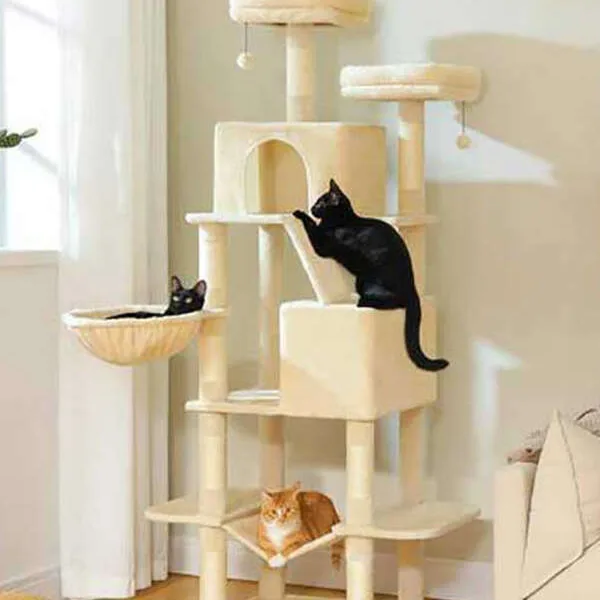
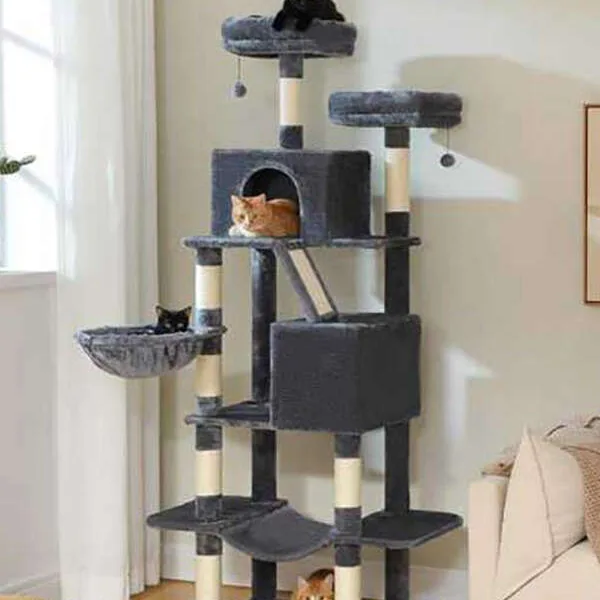
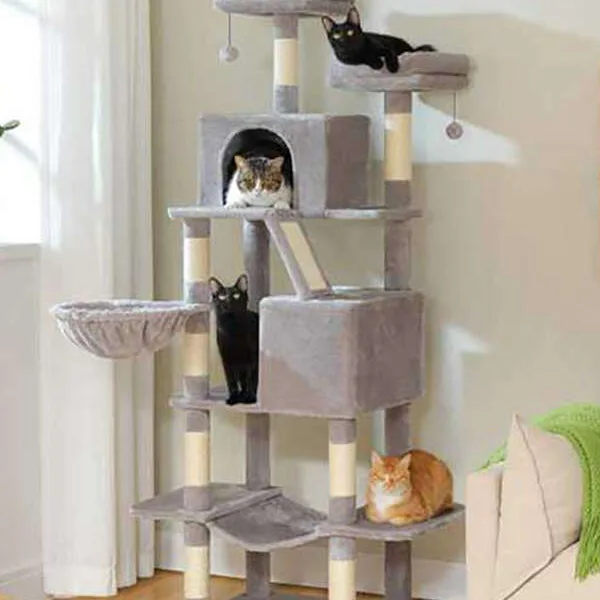
Buying checklist
- Ceiling type confirmed before the model is offered for that market
- Adjustment overlap of at least 5 cm at the target room height
- Tested load per platform stated in writing
- Pole wall thickness specified, not just diameter
- Carton dimensions and container loading plan confirmed
- Assembly instructions include tightening torque guidance
FAQ
Will a floor to ceiling cat tree damage my ceiling?
A correctly installed tension tower leaves only a small compressed ring where the rubber foot meets the ceiling, which usually wipes off. Damage happens when the foot is overtightened against plasterboard, or when the pole is placed under a weak section of ceiling rather than a joist.
Can it hold a large cat?
It can, but the limit is the ceiling, not the cat. Solid ceilings with a properly sized pole hold large cats comfortably. Suspended ceilings do not, regardless of how strong the pole is.
Do I need to drill into the wall?
No. That is the main reason people choose this type. Wall-mounted systems need fixings; tension towers do not.
Sourcing floor-to-ceiling towers for retail?
We manufacture tension towers with specified pole thickness, tested load per platform and retail-ready cartons. Tell us the market and height range, and we quote against it.
See the range