Cat Tree for Multiple Cats: Sizing for Two, Three or More
Two cats do not need twice the tree. They need two routes, two high points and enough width that one cat does not have to walk over another to get down.
The mistake: one big tower, one path
A single-column tower with platforms stacked on one axis forces every cat through the same route. In a multi-cat home that becomes a queue, then a standoff, then a fight — and the tree gets abandoned by the less confident cat.
The fix is not more height. It is a second route: either a double-column tree, or a tree plus wall shelves creating a loop.
Sizing by number of cats
| Cats | High points | Suggested form |
|---|---|---|
| 2 | 2 | Double-column tree, or one tree plus two wall shelves |
| 3 | 3 | Double column with a connecting bridge, or two trees linked by shelves |
| 4+ | 4+ | Modular system along one wall; treat it as furniture, not a single product |
Rule of thumb: one resting spot per cat, plus one. And each resting spot needs a route that does not pass through another spot.
Platform size for shared use
A large platform shared by two cats is not shared — the dominant cat takes it. Wide platforms help, but the real answer is depth in the layout: multiple resting spots at the same height, spaced apart, so neither cat has to concede the high ground.
Stability under moving load
Multi-cat trees get hit from several directions. Wider base, thicker posts, and joints that are mechanically locked rather than screwed into board. If the tree is taller than about 120 cm, plan for a wall strap.
Accessories that earn their place
- Replaceable sisal posts — with several cats, the posts wear out first
- Washable platform covers — multi-cat homes need them
- A second bowl bed — two cats will not share one
What to state on the listing
Multi-cat buyers are comparison shoppers. State the number of resting spots, the number of routes, platform dimensions and the tested load per platform. Vague claims like "suitable for multiple cats" do not convert; numbers do.
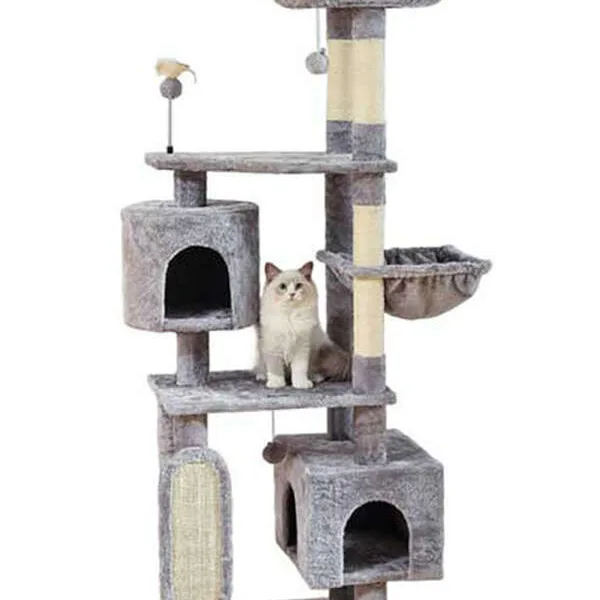
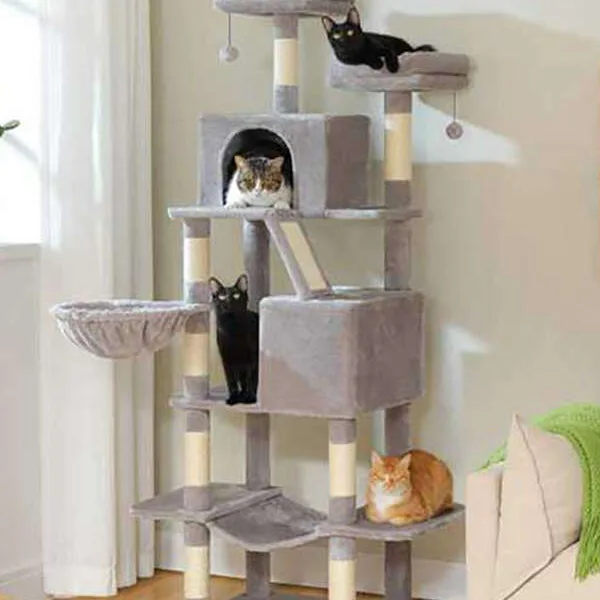
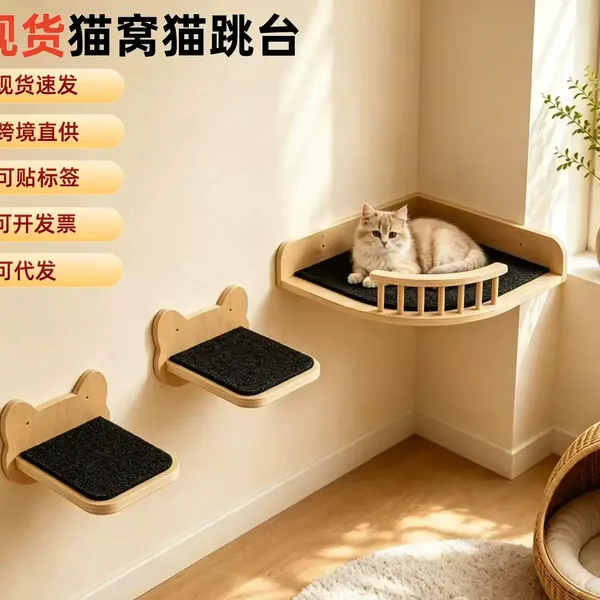
From our product catalogue
Real products we manufacture — sizes and options are on the product page.
Buying checklist
- Number of resting spots stated (cats + 1)
- More than one route between levels
- Platforms wide enough for a large cat to lie down
- Wall strap included above roughly 120 cm
- Replaceable sisal posts available as an accessory
FAQ
How many cat trees do I need for two cats?
One well-designed tree with two routes and two high points usually beats two small trees. Two small trees is the fallback when floor space allows it.
Do cats share cat trees?
They share the structure, not the resting spots. Providing more resting spots than cats is the single most effective way to prevent one cat from guarding the tree.
What breaks first on a multi-cat tree?
The sisal on the posts, then the joints. Both are predictable wear points, which is why replaceable posts and mechanically locked joints matter more in multi-cat homes.
Multi-cat configurations, quoted per project
Double-column trees, connector bridges and modular systems — we build them to your layout and state the tested load per platform.
See the range