Corner Cat Tree: A Triangular Base Buys Floor Space, Not Stability
A corner tower is sold as the space-saving option, and it is. But the reason to check one is not the footprint — it is what the two walls do to the load path, and what happens on the second and third floors of a building where one of those walls is not yours.
What actually changes when the base is triangular
A rectangular tower stands on its own four corners and is held upright by its weight and its base area. A corner tower is built to be pushed into a 90° corner, with two straight edges presented to the two walls and a diagonal face turned into the room. The moment you do that, the walls stop being decoration:
- The two back edges bear against the wall as flat faces, not as four individual feet. Load that would otherwise tip the unit sideways is transferred into the wall over a long line instead of a point.
- The diagonal front edge becomes the lean line. A cat jumping onto the top platform toward the room is pushing the tower across that diagonal, which is a shorter lever arm than a full side of a rectangle of the same area.
- The rear legs become the pivot. Once the unit starts to rotate about the back edges, no further wall contact helps — the corner has to stop it, or a strap does.
That third point is the one buyers miss. A corner tower against two walls is more resistant to sideways shunt than a free-standing rectangle, but it is not more resistant to rotation about the two back edges. The corner helps with one failure mode and not the other, and the models sold cheapest are the ones where the second failure mode is unaddressed.
The stability footprint of a triangle, done properly
Vendors quote base area. Area is the wrong number. What resists tipping is the distance from the centre of mass to the nearest edge that the unit can rotate about — the back edges in a corner install. Work that out for a right triangle pushed flush into a corner and you get a figure most listings never mention:
| Base legs along the two walls (cm) | Base area (m²) | Depth into the room at the diagonal (cm) | Pivot distance, corner to centre of mass (cm) | Pivot as a share of height |
|---|---|---|---|---|
| 55 × 55 | 0.15 | 38.9 | 19.5 | ~16% at 120 cm, ~14% at 140 cm |
| 60 × 60 | 0.18 | 42.4 | 21.2 | ~18% at 120 cm, ~15% at 140 cm |
| 70 × 70 | 0.25 | 49.5 | 24.7 | ~21% at 120 cm, ~18% at 140 cm |
| 60 × 75 | 0.22 | 46.9 | 23.4 | ~20% at 120 cm, ~17% at 140 cm |
| 70 × 80 | 0.28 | 52.7 | 26.4 | ~22% at 120 cm, ~19% at 140 cm |
Two readings follow. First, the pivot distance is roughly 0.7 × the leg length in every square case, so going from 55 cm legs to 70 cm legs buys about 5 cm of pivot — a modest gain for a 60% jump in base area. Second, and more useful for selection: the pivot sits at roughly a fifth of the tower's height. Anything at or above that ratio is behaving like a normal floor-standing tower; anything below it is a lever with a cat on the long end. On our own towers we would not put a corner unit taller than about 120 cm into a corner without a strap, and we say so before the order rather than after the complaint.
Effective floor saved is a third, not half
The selling claim is that a corner tower "uses space you were not using anyway". True, but the saving is smaller than the arithmetic suggests, because you cannot push the unit hard into the corner. Tension straps, wall straps and skirting boards all reserve a gap, and a cat landing on the diagonal front needs clearance in front of it.
Worked estimate for a 55 × 55 corner unit against a 45 × 45 rectangular tower of the same height, both installed as a shop would show them:
| Item | Rectangular 45 × 45, free-standing | Triangular 55 × 55, in a corner |
|---|---|---|
| Base area | 0.20 m² | 0.15 m² |
| Clearance you must leave | 10–15 cm on two or three sides | None on the two wall sides, 10–15 cm at the diagonal |
| Corner square required | ≈ 0.42–0.56 m² | ≈ 0.20–0.26 m² |
| Verdict | Needs a wall run and blocks one | Uses an otherwise dead corner |
So the honest claim is that a corner unit frees roughly a third of the wall-and-floor envelope a free-standing tower would take — enough to matter in a narrow room, not the halving that marketplace copy implies. Note also that the corner itself is not free: it is where people put floor lamps, plants and the router, and a tower with a strap into the wall cannot be moved to vacuum behind.
The two walls are not always yours to drill
This is the part that should be checked before the model is chosen, because it can rule out the whole category. A corner tower taller than roughly 1.2 m wants a strap to a fixing, and the strap pulls on whichever wall it is anchored to. In practice that anchoring wall is often the problem:
- Rented flats. Fixings into plasterboard or into a rendered masonry wall leave holes the tenant has to justify. A free-standing tower with a wide base and no strap can be the only acceptable option — and in that case a corner unit's main structural advantage is unavailable.
- Plasterboard without a stud where you need one. The corner itself is usually framed, but not always with a stud at the height the strap lands. A strap into bare board holds until it does not.
- Glazed or curtain-wall corners. New-build apartments sometimes have a window returning into the corner. There is nothing to fix to, and the unit's back edges now sit against glass.
- Shop and showroom installs. A retail display cannot be strapped at all, which is why the specification for the trade version of the same model is usually a heavier base, not a longer strap.
Ask the question in this order: which wall can I fix to, at what height, and with what anchor? If the answer is none, stay with a floor-standing tower and solve stability with base weight, not with the corner.
Triangular footprint, rectangular carton
Importers get caught by a detail that is invisible on the product page: the base is a triangle, the carton is not. Flat-packed, a corner tower usually breaks down to a base board roughly the size of the triangle's longest side and a stack of panels, so the carton is close in depth to a comparable rectangular tower's carton while the assembled unit claims 40% less floor area. That gap between the marketing figure and the freight figure is worth having in the quote negotiation.
Two checks before you commit to a container plan: confirm whether the base board ships as one piece or splits, because a single large board sets the minimum carton dimension and that dimension, not weight, limits units per 40HQ; and confirm how many cartons the kit is — a corner tower with a separate hardware and strap bag often ships two. Do not accept a "sets per container" number for a different model, because carton geometry varies more between tower families than the outer heights suggest.
How to judge one in a showroom or on a spec sheet
- Put the two back edges against a real corner. If there is a visible gap at the base and it does not close when pushed, the corner is not square and the strap will do the work instead of the walls.
- Lean on the diagonal face at platform height. This is the rotation mode the corner does not fix. A tower that rocks here will rock at home.
- Look for the strap and its anchor type in the box contents, not in the photos. If a strap is mentioned but no anchor is included, the buyer supplies it — and most will not.
- Check the top platform overhangs. A perch that hangs out over the diagonal face moves the centre of mass further into the room and shortens the pivot. It is the cheapest height in the product and the most expensive in stability.
- Measure the legs, not the height. Ask for both wall-leg lengths. A "45 cm corner cat tree" is often 45 cm on one leg and 60 on the other, which is a different pivot distance from a 45 × 45.
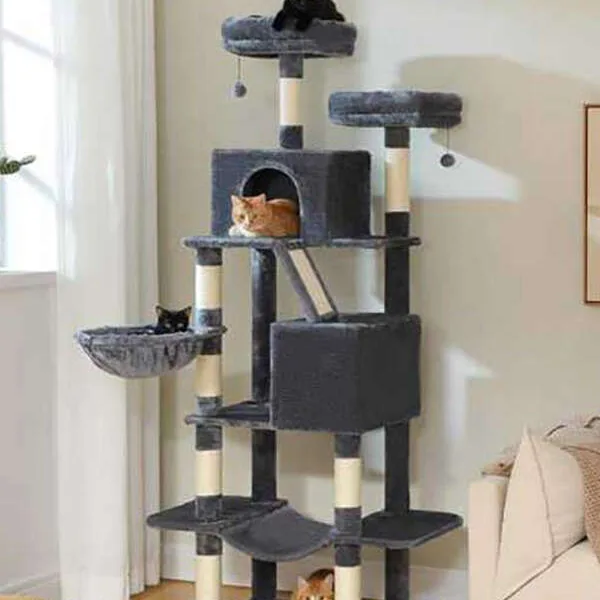
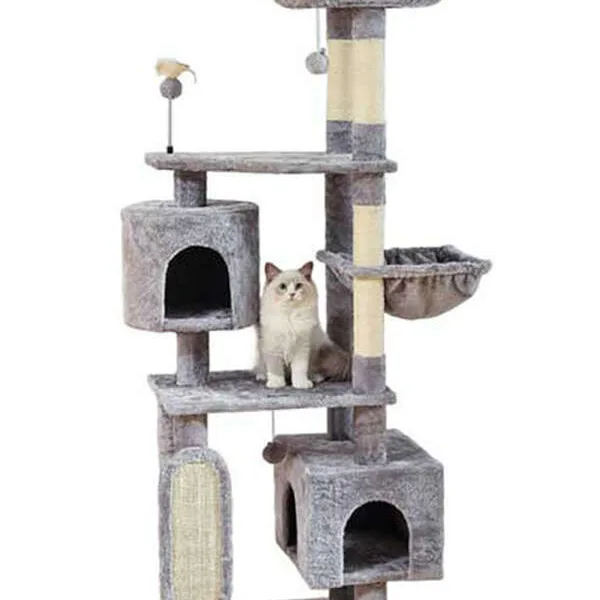
From our product catalogue
Real products we manufacture — sizes and options are on the product page.
Buying checklist
- Ask for both wall-leg lengths, not one — a 45 × 60 base behaves differently from 45 × 45
- Confirm the tower height against the leg length; above roughly 1.2 m a fixing is not optional
- Identify which wall the strap lands on and what anchor it needs before choosing the model
- Check the corner is genuinely square, or the walls stop carrying the load and the strap carries it
- Confirm carton count and whether the base board ships in one piece — board size limits units per 40HQ
- Measure skirting height: a base that cannot sit flush to the wall loses most of its triangular advantage
FAQ
Does a corner cat tree need to be screwed into the wall?
Below roughly 1.2 m, usually not — the two back edges against the walls plus the base weight are enough, provided the base legs are proportionate to the height. Above that height, yes: a strap to a proper fixing on one of the two walls is the standard specification, and models sold without one are relying on the buyer to improvise. The test is not how stable it feels when you push the middle of the tower, but how it behaves when pushed at platform height toward the room — that is the rotation about the back edges that the corner does not prevent. If neither wall can take a fixing, stay with a floor-standing tower with a wider base.
Is a triangular-base cat tree actually more stable than a square one?
More stable against sideways shunt, less stable than its base area suggests against tipping into the room. Pushed into a square corner, the two straight edges bear on the walls over their full length, which is a much better load path than four feet. But the unit pivots about the back edges, and the distance from the corner to the centre of mass works out at roughly 0.7 × the leg length — about a fifth of tower height. A 55 × 55 base gives you around 19 cm of pivot; a 70 × 70 gives about 25 cm for a much larger footprint. So the corner helps, and it does not replace the base-to-height ratio a free-standing tower would need.
How much floor does a corner cat tree really save?
Roughly a third of the wall-and-floor envelope a comparable free-standing tower takes, not half. The base area is smaller for the same climbing height, and the two wall sides need no clearance gap — that is where the saving comes from. But you still need clearance in front of the diagonal face for a cat to land, you cannot usually sit the base fully flush because of skirting boards, and the corner is often already occupied by a lamp or a plant that has to move. Treat any claim that the corner halves the space as marketing, and measure your own corner's usable square before ordering.
Specifying a corner unit for a market that will not accept wall fixings?
Tell us the corner square you have to work with, the mounting height, and whether the end customer can fix to a wall. We will come back with the corner models in our range with their wall-leg lengths, carton count and base data, plus the trade version with the heavier base where a strap is not an option.
See the rangeFloor to Ceiling Cat Tree: What to Check Before You BuyWall Mounted Cat Shelves: Load Ratings, Fixings and LayoutCat Tree for a Maine Coon: Sizing Rules That Actually WorkCat Tree for Multiple Cats: Sizing for Two, Three or MoreSisal Cat Tree Posts: What Actually Determines How Long They LastHow Tall Should a Cat Tree Be? A Practical Guide