Cat Tree Quality Inspection: What to Check Before the Container Leaves
Most cat tree defects are not visible in a photo of a finished unit. They live in panel flatness, sisal tension, hardware tolerance and carton strength — which is why an inspection has to be built from a checklist, not from enthusiasm.
Why cat trees fail inspection differently from other furniture
A cat tree is a loaded structure. Posts carry a jumping cat's weight plus the dynamic load of landing; platforms are cantilevered off those posts; and the covering is a wear surface that a cat uses daily with claws. That means the failure modes are structural and gradual, not cosmetic and immediate. A scratch on a panel is a claim; a post that loosens after three months of use is a refund, a bad review and a lost repeat customer.
The practical consequence for buyers: an inspection that only photographs the finished unit tells you almost nothing. The checks that matter happen on the components before assembly, and on the assembled unit under load. Everything below is organised that way.
Stage one: panels and board
| Check | How to test it | Failure looks like | Severity |
|---|---|---|---|
| Panel thickness consistency | Calipers at four points on each of five random panels | Variation beyond the agreed tolerance → hardware cannot pull tight, joints loosen | Functional |
| Flatness / warpage | Panel on a flat reference surface, check gap at corners | Rocking tower, uneven platform joints, gaps at screw heads | Functional |
| Edge banding adhesion and trim | Fingernail lift test at a corner and along a long edge | Lifting band catches on carpet, moisture wicks into the core | Functional over time |
| Hole positions and pilot depth | Test-assemble one unit fully with the supplied hardware | Screws strip, cross-thread, or do not seat — the whole batch assembles badly | Functional, batch-wide |
| Surface finish uniformity | Compare panels from the first and last carton in the run | Colour drift between cartons — returns when sets are sold as matching | Cosmetic, commercial impact |
Note the fourth row. Hole position is the single most common batch-wide defect in flat-packed pet furniture, and it is invisible unless someone actually assembles a unit with the hardware that will ship in the box. Inspecting panels that were hand-fitted in the factory, with jigs that will not travel, proves nothing.
Stage two: sisal posts and covered surfaces
| Check | How to test it | Failure looks like | Severity |
|---|---|---|---|
| Sisal / rope tension | Firm push with a thumb along the length, both ends and the middle | Loose windings that slip down the post the first week of scratching | Functional |
| End termination | Pull the wrap at both ends by hand | Loose tail that unravels progressively from one end | Functional |
| Adhesive coverage under the wrap | Inspect a cut sample or the post end if permitted | Rope that tightens and gaps under load — often shows as ringing gaps after assembly | Functional |
| Carpet/plush bond to platform | Corner lift test with fingernail; check wrapping at the edges | Lifting fabric at the edges, glue lines through the pile | Cosmetic to functional |
| Post straightness | Roll on a flat surface, or sight along the length | Visibly bowed tower; platforms meet posts at an angle | Functional |
Sisal tension is the check most often skipped because it feels subjective. It is not: a firm thumb push that lets the rope move is a fail, and the same sample tested by two people should reach the same conclusion. If your inspector cannot describe the test in one sentence, the report will be a matter of opinion and the supplier will argue with it.
Stage three: hardware and assembly
Hardware is cheap and it is where the most expensive complaints start. Three things belong on the checklist, and none of them can be verified from a photograph of a packed bag:
- Count and type match the bill of materials — counted against the BOM for the specific model, not against "a typical bag". Mixed-model orders are where counts go wrong.
- Thread engagement in a real test assembly — screws must seat without stripping in the actual boards being shipped, not in a pre-production sample kept on a shelf.
- Bracket and connector strength — the joint between post and platform carries the whole load. Check that the bracket is the specified gauge and that fixings are the specified length; a shorter screw is functionally the same as a missing one.
Add a load test if the product is aimed at large cats or multi-cat households: put a representative static load on the highest platform and observe the joint, then check the joint again after the load is removed. What you are looking for is permanent deformation or a loosened fixing, not a bend that springs back.
Stage four: cartons and packing
Quality that arrives broken is not quality. The carton checks are unglamorous and they protect the whole margin:
- Carton board grade and burst strength against the agreed specification — measure, do not read the printing.
- Drop test on a packed carton — corners and one edge, then open and inspect contents.
- Internal protection — corner protectors, corner blocks, or whatever the packing specification names, present and positioned as specified.
- Carton weight and dimensions against the loading plan — if the carton grew, the container fill you were quoted no longer holds.
- Artwork correctness — barcode, model code, country of origin marking, and any retailer-specific labelling, checked against the approved artwork file.
Sampling, and why "inspect everything" is the wrong answer
Full inspection of a container of flat-packed furniture is expensive and rarely justified. The usual professional approach is a documented sampling plan: a defined number of cartons pulled at random across the run, a defined number of units assembled from those cartons, and defects classified before the inspection so the pass/fail decision is arithmetic rather than argument.
| Defect class | What belongs in it | Typical disposition |
|---|---|---|
| Critical | Safety-relevant: joint failure under load, hardware that cannot be assembled, board that cracks at fixing points | Batch rejected regardless of defect count |
| Major | Functional: loose sisal, warped panels, wrong hardware count, carton below specified grade | Rework or replace within an agreed allowance |
| Minor | Cosmetic: small finish marks, banding trims, label alignment | Accepted within an agreed limit |
Agree the classifications, the sample size and the defect limits in the purchase order, before production. An inspection where the inspector decides what counts as a major defect, after seeing the goods, will not settle a claim.
Building this into your purchase order
An inspection is only as good as the standard it measures against. Before production, get these four things into the PO or its annex: the measurable specification (board grade, panel thickness tolerance, sisal type, hardware BOM), the defect classification table, the sampling plan and the point at which inspection happens — ideally before packing, so rework is possible without unpacking a container. Then a third-party inspection becomes a cheap enforcement mechanism rather than a second opinion you have to argue about.
What we do not publish
We do not publish numeric tolerances on this page — board thickness allowance, thread engagement, burst strength, allowable defect counts — because they depend on the board grade and specification agreed for each order, and a published figure becomes a claim we would have to defend on a product that was never quoted to it. What we do instead: for any model under discussion, we send the measurable specification sheet and the defect classification table we will be inspected against, so you can put them straight into your purchase order.
From our product catalogue
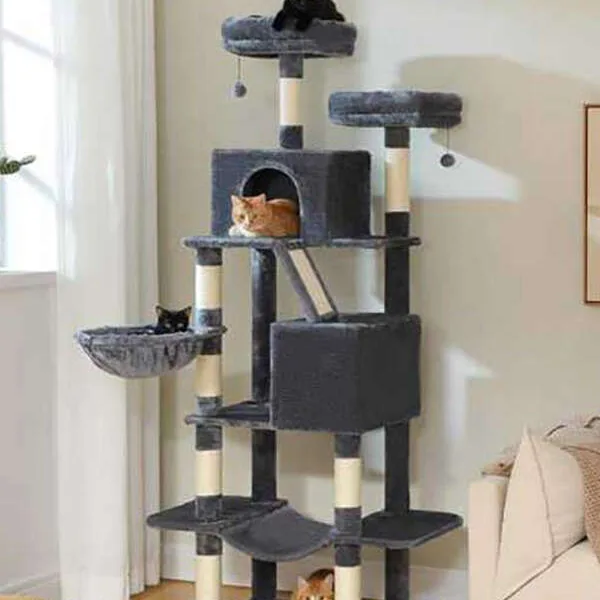
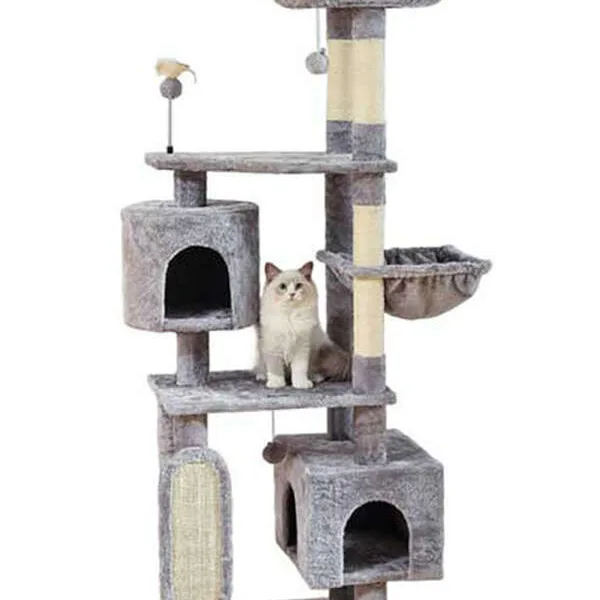
Real products we manufacture — sizes and options are on the product page.

Buying checklist
- Measurable specification agreed in writing before production: board grade, panel thickness tolerance, sisal type, hardware BOM
- One unit fully assembled with the shipping hardware, by the inspector — not by the factory
- Sisal tension and end termination tested by hand on multiple posts, not judged by photo
- Load placed on the highest platform, joint inspected during and after
- Packed carton drop-tested, then opened and contents inspected
- Defect classification and pass/fail limits written into the purchase order
- Inspection timed before packing, so rework does not mean unpacking a loaded container
FAQ
What should a pre-shipment inspection of cat trees actually check?
Four stages, in this order: panels (thickness consistency, flatness, edge banding, hole positions proven by assembling a unit with the shipping hardware), posts and covered surfaces (sisal tension, end termination, adhesive coverage, carpet bond, post straightness), hardware and assembly (BOM count, thread engagement in real boards, bracket gauge, a load test on the highest platform), and packing (carton board grade, drop test, internal protection, carton dimensions against the loading plan, artwork and markings). An inspection that only photographs assembled units skips the checks where the real defects are.
Should I inspect every carton or use sampling?
Sampling is the normal professional approach for flat-packed furniture; full inspection is expensive and rarely changes the outcome. Use a written sampling plan: a set number of cartons pulled at random across the run and a set number of units assembled from them, with defects pre-classified as critical, major or minor and limits agreed in the purchase order. The key is that the standard is fixed before the goods exist, so the pass/fail decision is arithmetic rather than a debate with the supplier after the fact.
What is the most common batch-wide defect in cat trees?
Hole position and hardware fit. When panels are cut or drilled slightly off, the problem is not one bad unit — every set in the batch assembles badly, with screws that cross-thread or strip and joints that never pull tight. It is invisible in photographs and cannot be disproved by assembling a pre-production sample the factory has kept on a shelf. The only reliable check is for an independent inspector to assemble a unit drawn from the actual production cartons using the hardware packed in those same cartons.
Want the specification sheet your inspection can measure against?
Tell us which models you are considering. We will send the measurable specification sheet and the defect classification table for that product, so you can put them straight into your purchase order and have the goods inspected against numbers rather than opinions.
See the rangeFloor to Ceiling Cat Tree: What to Check Before You BuyWall Mounted Cat Shelves: Load Ratings, Fixings and LayoutCat Tree for a Maine Coon: Sizing Rules That Actually WorkCat Tree for Multiple Cats: Sizing for Two, Three or MoreSisal Cat Tree Posts: What Actually Determines How Long They LastHow Tall Should a Cat Tree Be? A Practical Guide