Cat Tree Manufacturer in China: What to Verify Before You Place a P.O.
Most 'manufacturer' listings on sourcing platforms are trading offices. The difference rarely shows in the price list — it shows up in month three, when a container is late or a carton arrives crushed. Here is what to check, in order.
1. Scale should be checkable, not just claimed
Factory scale is the fastest way to separate a producer from a forwarder, because it comes with verifiable detail: a floor area, a number of lines, a worker count, and a known audit. Ask for all four together — a real factory answers without hesitation because these numbers are how it quotes capacity to buyers every week.
The useful reference frame for cat furniture: this is a labour-heavy, low-automation product. Cutting and drilling can be automated, but sisal wrapping, fabric covering and final packing are mostly manual. That means worker count and line count predict capacity far better than floor area does. A 15,000 m² building with three packing tables is not a large factory.
2. Which components are made in-house
Almost no cat tree factory makes everything. Board panels, metal brackets, plastic connectors, cushions and printed cartons are commonly split across suppliers. Ask for a component-by-component answer, because each outsourced part is a delay risk you inherit.
| Component | Why the answer matters |
|---|---|
| Board cutting and edge banding | In-house means you can change a platform size without waiting on a panel supplier |
| Sisal covering on posts | The main hand-labour step and the most common bottleneck in peak season |
| Fabric cutting and sewing (cushions, condos) | Determines whether colour and fabric changes are realistic on small runs |
| Metal brackets and screws | Usually bought in; ask which standard they follow, as it drives wobble complaints |
| Printed cartons | Usually outsourced — this is where private-label lead times are actually decided |
3. MOQ depends on what you are asking for
Buyers compare MOQ numbers without checking whether they describe the same thing. They almost never do. The honest way to read a MOQ figure is by change type:
| What you are asking for | Typical MOQ structure | What drives it |
|---|---|---|
| An existing model, existing colour, existing carton | Lowest — basically a pallet or partial-container quantity | Whether stock exists between production runs |
| Existing model, your logo on product or carton | Mid — a small multiple of the above | Print plate setup and mixed-model packing |
| New size, new fabric or new structure | Highest — full run per model | Sampling rounds, panel tooling, sewing pattern |
Ask for the three numbers separately and in writing. A single headline MOQ number is a sales number, not a production number. Exact figures depend on the model and on current line loading — we confirm them per inquiry rather than publish a blanket number.
4. Sampling: the step that reveals organisation
Sample lead time is the best proxy for how the factory will behave on a real order. A factory that quotes a sample in a defined number of working days, gives a tracking number without being chased, and sends the sample with the hardware it will actually ship with, is organised. One that produces a beautiful sample with different fittings than the spec is telling you something about the bulk order.
Ask two extra questions while sampling: does the sample cost get credited against the bulk order, and can two or three models be sampled in the same round? The answers tell you how much flexibility exists in the schedule.
5. Cartons and loading: the numbers that decide landed cost
Cat trees are bulky and cheap per cubic metre. Two suppliers can quote the same FOB price and deliver very different landed cost because of packing density. Before comparing, request: carton dimensions, gross weight, units per carton, and units per 20GP and per 40HQ for the specific model — not a general claim.
Also ask whether the model ships flat-packed (knock-down) with hardware in a bag, and how the corner protection works. Flat-pack kits with good corner protection reduce both freight volume and transit damage; assembled shipping is almost never worth it for this category.
6. Documents to obtain before the first payment
- Business licence matching the company name on the proforma invoice
- The audit or certification documents the supplier claims, in the name of that legal entity — not a group company
- A written QC checklist naming inspection points for this product
- Payment terms: deposit, production, balance against documents copy, and what happens on a damaged carton claim
If a certificate is quoted as a selling point but the paperwork is in another company's name, treat it as unverified until you see a document that matches the entity invoicing you.
From our product catalogue
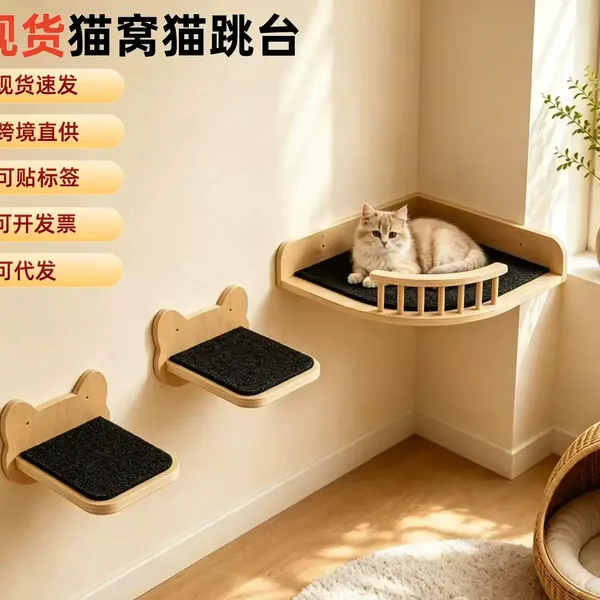
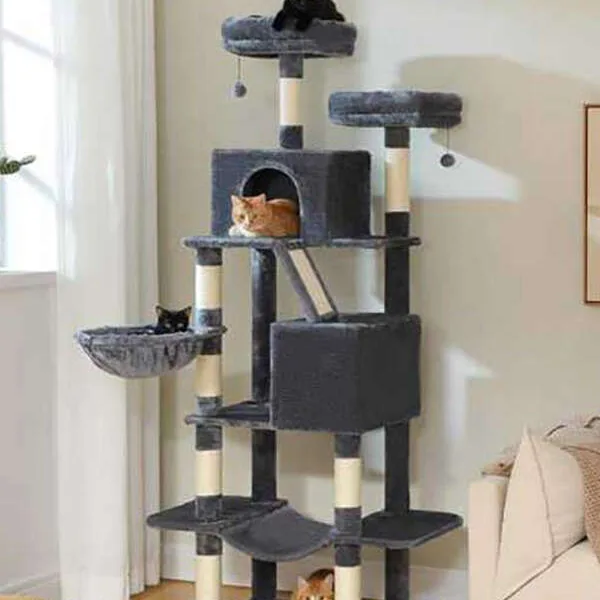
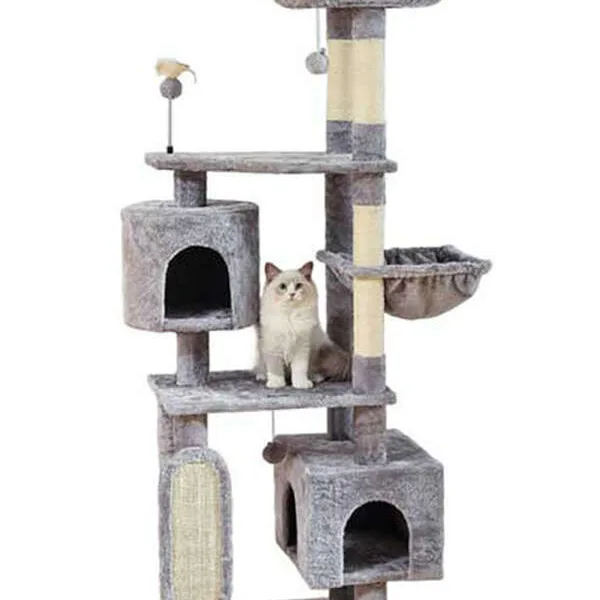
Real products we manufacture — sizes and options are on the product page.
Buying checklist
- Floor area, line count, worker count and audit asked for together
- In-house versus outsourced components listed by part
- MOQ requested separately for stock, logo and new-tooling orders
- Sample lead time quoted in working days, with hardware matching the spec
- Carton size, gross weight, units per carton, units per 20GP and 40HQ in writing
- Certificates and licence checked against the invoicing entity
FAQ
How do I know if a cat tree supplier in China is a real factory?
Ask for details only a producer holds: floor area, number of production lines, worker count, the audit it has passed, and which components it makes in-house. Then check that the business licence matches the company name on the invoice. Trading companies can forward a price list; they struggle to describe lines and components they do not operate.
What is the MOQ for a cat tree order?
It depends on what you change. Repeat orders on an existing model are the lowest, logo printing sits in the middle, and a new size or fabric requires a full production run. Ask for those three figures separately rather than accepting one headline number.
Can I visit the factory before ordering?
Yes, and for a first container it is worth it. If travel is not practical, ask for a live video walkthrough of the cutting, sisal wrapping and packing areas, plus the QC checklist — and check that the premises match the address on the business licence.
Request a quote with carton plan and loading quantity
We manufacture cat trees and pet furniture in Ningbo, and quote with production lead time, carton dimensions and container quantities attached, so you can compare landed cost properly.
See the rangeFloor to Ceiling Cat Tree: What to Check Before You BuyWall Mounted Cat Shelves: Load Ratings, Fixings and LayoutCat Tree for a Maine Coon: Sizing Rules That Actually WorkCat Tree for Multiple Cats: Sizing for Two, Three or MoreSisal Cat Tree Posts: What Actually Determines How Long They LastHow Tall Should a Cat Tree Be? A Practical Guide