Cat Tree for a Small Apartment: Measure the Footprint Before You Measure the Height
In a studio or a one-bedroom flat, the question is never "how tall can the cat tree be" — it is "how much floor does this tower take away from me, permanently." Those are two different numbers, and only one of them is printed in the product listing.
The number missing from every listing: the stability footprint
A cat tree does not occupy its base dimension. It occupies its base dimension plus the clearance you need around it so it does not walk across the floor when a cat lands on the top platform. A tall tower with a small base is a lever: the taller the lever, the harder the load at the top pushes the base sideways. That is why two towers with identical 40 × 40 cm bases are not equivalent — the 180 cm one needs noticeably more clearance behind it than the 70 cm one, and in a small flat that clearance is exactly what you do not have.
The practical rule we would give a buyer: enter it with a stability margin. Whatever the base is, plan for roughly 10–15 cm of clear space on the two or three sides a cat can land from, and more for a tower over about 140 cm. Behind a tall tower you want it against a wall or a fixed piece of furniture, not standing free in the room — a wall is the cheapest stabiliser you have.
Real dimensions, from our own range
Rather than quote generic figures, here is a like-for-like comparison of towers we actually build, spanning the compact end to the large end. All are flat-packed, board-and-paper-tube construction with sisal posts.
| Type | Product dimensions (cm) | Approx. floor taken with clearance | Best fit | Main trade-off |
|---|---|---|---|---|
| Compact 3-tier | 35 × 30 × 70 (W × D × H) | ≈ 0.30–0.35 m² | Studio, one-bedroom, hallway, second unit | Low; limited climbing, suits one smaller cat |
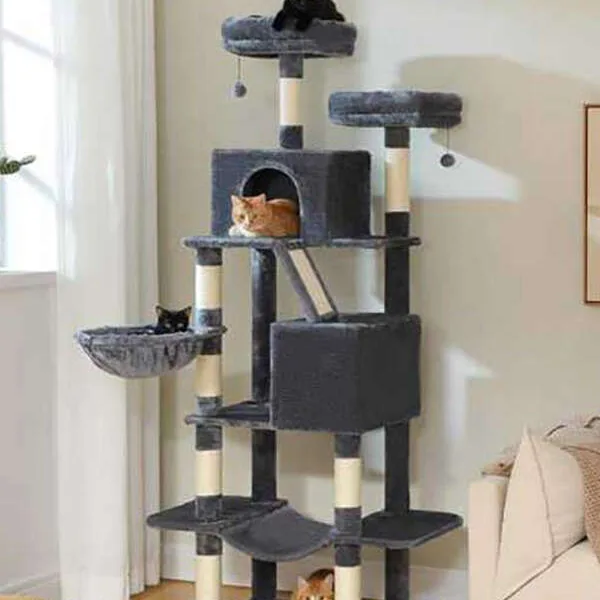
| Compact 4-level, basket condo | 45 × 40 × 133 | ≈ 0.45–0.55 m² | Small apartment, one or two cats | Tall enough to need a wall behind it |
| Mid tower, 4-level | 60 × 45 × 145 | ≈ 0.60–0.75 m² | Apartment with a defined cat corner | Base depth eats into a narrow walkway |
| Mid tower, 4-level (deep) | 60 × 45 × 148 | ≈ 0.60–0.75 m² | Two cats, room with wall space | Depth, not height, is the constraint |
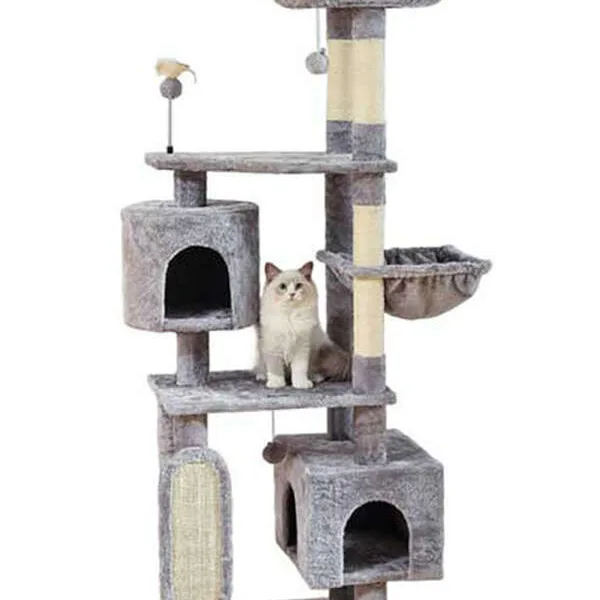
| High-rise tower | 155 cm class, ~60 × 45 footprint | ≈ 0.75–0.90 m² | Open-plan living room, large cats | Needs real clearance; wrong choice for a studio |
Read the "floor taken" column as planning guidance, not a specification: it applies the clearance rule above to the listed base. The point it makes is the one that matters — moving from a 35 × 30 base to a 60 × 45 base roughly doubles the floor you give up, while only adding about 10 cm of depth on paper per side. Depth is the expensive dimension in a narrow flat, and base depth is the first thing to check against your walkway width.
Where the wasted space actually comes from
Most people who feel their cat tree "took over the room" are reacting to three specific losses, and each has a different fix:
- Dead clearance behind the tower. A tall tower pulled 40 cm off the wall to look "centred" sacrifices a strip of floor you can never use. Fix: put the back of the base against a wall and accept an asymmetric position. Nobody measures centring; everybody walks into a gap.
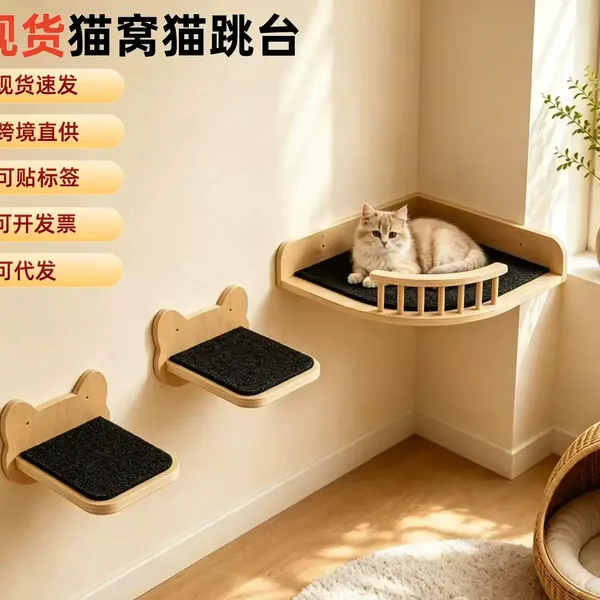
- The corner you are not using. A round or wide-based tower sits badly in a corner. A unit whose base is roughly square, or a wall-mounted board system, uses a corner that was otherwise dead — which is the single largest source of free floor area in a small flat.
- The unit that is too small to be used. This one is counter-intuitive. A tiny tower that wobbles gets avoided by the cat, so you keep it and still buy a second one — now you own two footprints. A stable compact unit at the 70–133 cm range is usually the better use of floor than an unstable novelty piece.
Height versus floor: the honest trade-off
Cats want vertical space, and a small apartment is short of it. The standard advice is "go tall because you are short of width" — that advice is right, with one condition: the tower must be stable enough to be used at full height. So the selection order for a small flat is:
- Fix the footprint budget first. Measure the corner or wall run you are willing to give up, in centimetres, including clearance. That number decides which group of towers you are shopping in, not the other way round.
- Then take the tallest tower that fits that budget with a wall behind it. Within a given base, height is nearly free floor space.
- If the budget is genuinely tiny, go vertical on the wall instead. A wall-mounted shelf system uses zero floor and gives a cat the same climbing route. The cost is installation: it needs fixing into something structural, and it is not a rental-friendly option in most leases.
What compact does not have to mean
A compact tower is often assumed to be a compromise on materials — thinner board, shorter sisal posts, hardware that gives up early. It does not have to be, and the checks are the same ones that apply to a large tower: board grade, sisal tension at both ends, post straightness, and whether the post-to-platform joint holds a load at the top platform. What changes with a compact unit is where the load goes: with a smaller base, the joint between the lowest post and the base panel takes relatively more of the landing force, so that is the joint worth testing first.
Buying compact towers wholesale
For a retailer or an importer, the small-apartment segment has one commercial property that large towers do not: carton economics. A compact unit ships in a smaller, lighter carton, so the container loads more units per cubic metre and the per-unit freight share falls — which is what makes a low price point viable in a market where the end customer is a renter with limited space. The trade-off is that compact units are also the segment most exposed to price competition, so differentiation has to come from stability, finish and packaging, not from the price itself.
From our product catalogue
Real products we manufacture — sizes and options are on the product page.
Buying checklist
- Measure the floor you are willing to give up in cm, including 10–15 cm clearance on the landing sides
- Check the base depth against your narrowest walkway before checking the height
- Plan to place a tower over ~140 cm against a wall, not free-standing
- Confirm the compact model is genuinely stable — an unused tower is a second tower you will buy
- For a rental, decide wall-mounted versus floor-standing before ordering anything
- Weigh carton size per unit if you are importing — it drives the landed cost at this price point
FAQ
How much floor space does a cat tree actually take in a small apartment?
More than the base dimension printed on the listing. A tower occupies its base plus clearance on the sides a cat can land from — plan 10–15 cm, more for a tower over about 140 cm, and put the back against a wall so the clearance is only needed on two or three sides. As a planning reference from our own range: a 35 × 30 cm compact unit works out at roughly 0.30–0.35 m² of floor, a 45 × 40 cm unit at roughly 0.45–0.55 m², and a 60 × 45 cm tower at roughly 0.60–0.75 m². Moving up one base size roughly doubles the floor you give up.
Is a tall cat tree or a short one better for a small apartment?
Taller is usually the better use of space, because height is nearly free floor area — but only if the tower is stable enough to be used at full height. Fix your footprint budget first, then choose the tallest tower that fits that budget with a wall behind it. If the budget is genuinely tiny, a wall-mounted shelf system gives a cat the same vertical route at zero floor cost, at the price of installation and not being rental-friendly in most leases.
Do compact cat trees use cheaper materials than large ones?
They should not, and the checks are identical: board grade, sisal tension at both ends of the post, post straightness, and whether the post-to-platform joint survives a load on the top platform. What changes is where the load concentrates. With a smaller base, the joint between the lowest post and the base panel carries relatively more of a landing cat's force, so that is the joint to test first on a compact unit. If a supplier discounts a compact tower by thinning the board or shortening the sisal, the saving shows up as instability and the cat stops using the unit.
Sourcing compact cat trees for apartment-sized buyers?
Tell us the floor footprint your market is working with and the carton size you need to hit for your freight. We will send the compact and mid-size models in our range with their product dimensions and carton data, so you can compare landed cost per unit before choosing.
See the rangeFloor to Ceiling Cat Tree: What to Check Before You BuyWall Mounted Cat Shelves: Load Ratings, Fixings and LayoutCat Tree for a Maine Coon: Sizing Rules That Actually WorkCat Tree for Multiple Cats: Sizing for Two, Three or MoreSisal Cat Tree Posts: What Actually Determines How Long They LastHow Tall Should a Cat Tree Be? A Practical Guide