Cat Tree for Senior Cats: Engineer for the Way Down, Not the Climb
Most cat furniture is designed around going up: how high, how many levels, how much it holds. A cat over ten breaks that assumption. Going up is still possible for most of them; what they stop doing is coming down fast, and the refusal shows up as a tower that is used only at the bottom.
What actually changes after about ten years
The common life-stage conventions put "senior" somewhere around 10–11 years, but the calendar is a poor guide on its own. What changes is not strength so much as shock tolerance. Veterinary literature routinely reports that a large majority of cats past ten carry radiographic signs of degenerative joint disease — often in the elbows, shoulders and hips — and frequently with no obvious limp at rest. The owner sees none of that. The owner sees a cat that used to sleep on the top platform and now sleeps on the second one, or on the sofa back.
Three consequences follow for the furniture, and they are all geometric:
- The descent becomes the binding constraint. Cats come down head-first, taking the load through the forelimbs. A rising cat can stop mid-climb and reconsider; a descending cat has already committed to the drop.
- Long reaches get replaced by no attempt at all. A senior cat does not fail a jump and try again. It evaluates, declines, and finds somewhere else — permanently.
- Comfortable surfaces start to matter as much as structure. Hardboard platforms with no grip and no edge lip are where an older cat slips once, and then avoids.
Step height is a joint-load number, not a style choice
Landing load scales with drop height, and it scales linearly with height divided by the distance the limbs travel while absorbing it. If a cat lands from a rise of h and the legs flex through a distance s before the body stops, the average deceleration is about h/s times body weight. That is a simplification — it ignores the peak being higher than the average, and it ignores how the cat distributes load between fore and hind limbs — but it is the right shape, and it is enough to show why 15 cm and 45 cm are not "both just a step".
| Rise (cm) | Touch-down speed (m/s) | Average load at 6 cm limb flex (× body weight) | For a 5 kg senior cat |
|---|---|---|---|
| 15 | 1.7 | 2.5× | ≈ 12 kg equivalent — a step, not a jump |
| 20 | 2.0 | 3.3× | ≈ 17 kg equivalent — the practical ceiling for most seniors |
| 25 | 2.2 | 4.2× | ≈ 21 kg equivalent — acceptable for a fit mature cat, not for an arthritic one |
| 30 | 2.4 | 5.0× | ≈ 25 kg equivalent — young-adult territory |
| 45 | 3.0 | 7.5× | ≈ 38 kg equivalent — the standard 3-platform tower drop |
| 60 | 3.4 | 10.0× | ≈ 50 kg equivalent — top platform of a tall tower, straight to the floor |
The important row is the last one, because that is what a conventional 160–180 cm tower actually asks of a cat: not the 40 cm between platforms, but the full drop from the top when the cat decides to skip the intermediate levels — which is exactly what a cat in discomfort does to shorten the trip. The drop it chooses is the one that hurts, not the one on the drawing.
Slope beats steps. A ramp at 25–30° needs a run of about 1.7–2.1 times the rise it covers: 40 cm of height becomes 70–85 cm of ramp. That is real space in the room and real panel in the carton, and it is still the cheapest way to keep a whole tower in use, because it converts a drop into a walk.
A spec you can quote, by life stage
These are our design recommendations, not measured thresholds and not a veterinary prescription. They exist so that a buyer and a factory are arguing about the same numbers:
| Stage | Max rise per move | Platform short side | Max single drop | Surface and edges | Sleeping height |
|---|---|---|---|---|---|
| Young adult (1–6) | 30–40 cm | 30 cm | One level | Carpet or sisal; hardboard acceptable | Any |
| Mature (7–10) | 25–30 cm | 32 cm | One level, with a mid landing | Textured surface on every landing | Upper third |
| Senior (11+) | ≤ 20 cm, or a ramp at ≤ 30° | 35 cm | ≤ 40 cm, ideally 20 cm | Non-slip, plus a 2–3 cm lip or bolster | Mid height, 40–80 cm |
| Geriatric / diagnosed | ≤ 15 cm, ramps throughout | 38–40 cm | ≤ 20 cm | Non-slip and padded; no bare board | 25–40 cm, easy to step into |
Two of those columns are the ones a spec sheet usually omits and a senior cat notices first. Maximum single drop is the number that decides whether the top of the tower stays in use, because a cat that cannot face the drop will not make the climb. Sleeping height matters because the instinct to be high does not disappear with age — it just gets traded for a surface the cat can get on and off without a decision. A 40–80 cm bed with a bolster gives an older cat the elevated, protected feeling of a high perch at a height it can still use, and it is the part of the unit that gets the most hours.
What a senior variant costs to add
This is where the conversation usually gets easier, because it is not a new product. Take an existing tower and change three things: split the two longest rises into three shorter ones, add one ramp, and put a bed at mid height instead of on top.
- Panels. Two extra platforms at 35 × 30 cm plus a ramp at 70 × 30 cm is about 0.42 m² of additional board per unit. At 15 mm board and roughly 650 kg/m³ that is about 4 kg of added mass — arithmetic on the stated panel sizes, not a weighed figure from a prototype.
- Posts and tooling. Unchanged if the outer height and footprint stay the same. No new tooling, no new carton length.
- Carton. The added panels change carton count or carton height. Confirm which before the loading plan is fixed, because that is what moves the container maths, not the footprint.
- Assembly. Two more fixing points and one ramp bracket. In our experience this is the line where a factory either absorbs the cost or starts charging for a "senior" version that is the same tower with a different label.
The commercial argument for carrying a senior variant is not sentiment. It is that the returns in this category are rarely "broken" — they are "unused", which no warranty covers and no test report catches. A tower that a fifteen-year-old cat can walk down is a tower that stays in the room for another five years.
From our product catalogue
Real products we manufacture — sizes and options are on the product page.
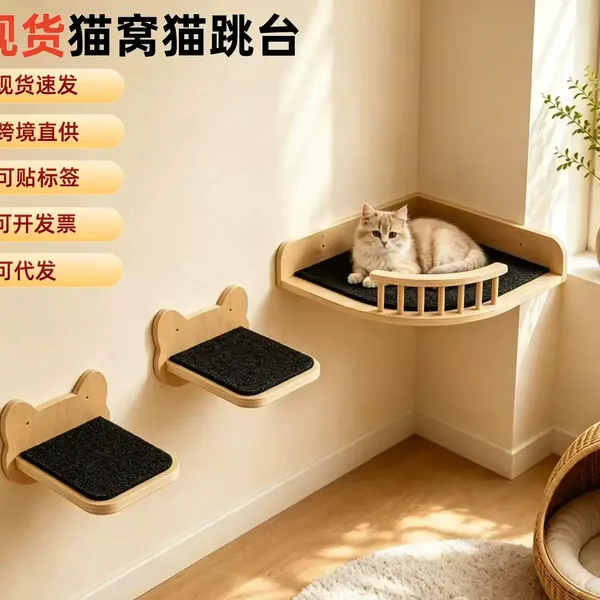
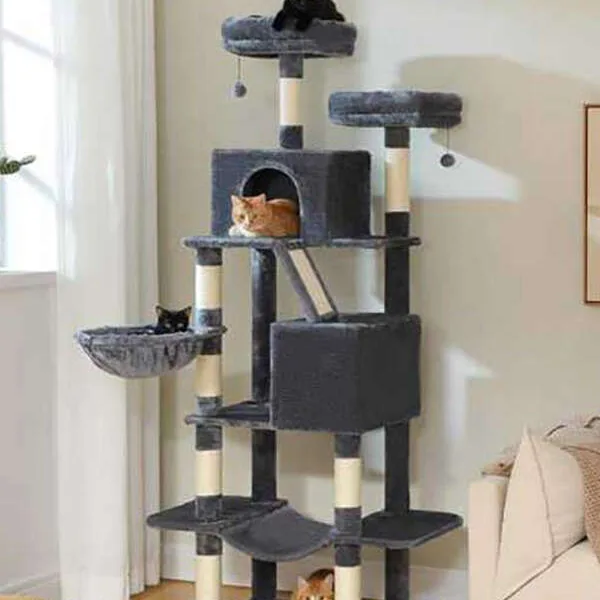
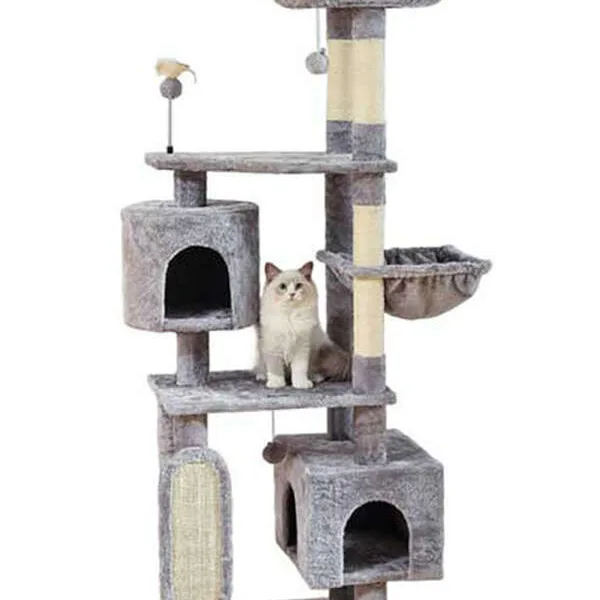
Buying checklist
- Measure the biggest single drop a cat can take in this unit — that number, not the height, decides if the top stays in use
- Every rise ≤ 20 cm for an 11+ cat, or replaced by a ramp at 25–30° (run ≈ 1.7–2.1× the rise)
- Platform short side 35 cm or more, with a non-slip surface and a 2–3 cm lip
- Sleeping bed at mid height (40–80 cm), not only on the top platform
- No gap between levels: consecutive platforms should overlap in plan view, not require a horizontal leap
- For a senior SKU: confirm how two extra panels and a ramp change carton count or height before fixing the loading plan
FAQ
My 13-year-old cat has stopped using the top of the tower. Is that arthritis or the furniture?
Treat it as a measurement first. Check the biggest drop the cat has to take to get down — if the top platform is more than about 40 cm above the next usable one, most older cats will stop going up there regardless of how well they feel, because the descent is the part they have to commit to. Then check the landing surfaces: a hardboard platform with no lip, or carpet worn smooth, gives a cat one slip and a permanent reason to avoid the level. If both of those are fine and the cat is still declining, that is a conversation for a vet rather than a furniture change — what a tower can do is remove the geometric reasons, not treat the joint.
Can I retrofit a ramp or extra step onto a tower I already have?
Usually yes, and it is worth doing before replacing the unit. The two workable retrofits are an intermediate platform bolted between two levels that are too far apart, and a ramp from the floor or from a low platform up to the first level the cat still uses. For the ramp, keep the slope at 30° or less — that means roughly 70–85 cm of run to cover 40 cm of height — and make sure the top end overlaps the platform rather than butting against its edge, or the cat has to step up onto a lip at the exact moment it has least grip. The load path matters too: a ramp bolted only to a thin platform panel will flex, so it needs to land on a post or a bracket, not on board alone. Ask for the fixing points and the ramp's own load rating in writing if the unit is going into retail.
Do senior cats still want to be high up?
Yes, and that is the part most senior-friendly designs get wrong. The drive to be elevated and to have their back covered does not disappear with age; what disappears is the willingness to pay for it with a difficult descent. The practical answer is to keep the height available but make the route to it cheap: a mid-height bed at 40–80 cm with a bolster or a side wall, reached by a ramp or a 20 cm step, is used far more than a top platform at 150 cm reached by a 45 cm jump. If you keep a high perch, give it two ways down, and put a landing under it so the cat never faces a full-height drop.
Adding a senior-friendly variant to your range?
Send us the tower you already buy — height, platform sizes, carton dimensions — and we will come back with the step split, ramp dimensions, panel and mass impact, and how the carton changes, so you can price the variant before you commit to a mould or a container.
See the rangeFloor to Ceiling Cat Tree: What to Check Before You BuyWall Mounted Cat Shelves: Load Ratings, Fixings and LayoutCat Tree for a Maine Coon: Sizing Rules That Actually WorkCat Tree for Multiple Cats: Sizing for Two, Three or MoreSisal Cat Tree Posts: What Actually Determines How Long They LastHow Tall Should a Cat Tree Be? A Practical Guide