Cat Tree for a Ragdoll: Buy for the 9 kg Adult, Not the 4 kg Kitten
A Ragdoll does not test a cat tree the way a Bengal does. It does not leap at the top platform and try to bring it down. It climbs slowly, lies down across the platform, lets its legs and tail hang over the edge, and stays there for six hours — and that is a harder load to design for than a jump.
Why "big cat = big tower" is the wrong rule here
Ragdolls are big, but their size is distributed differently from a Maine Coon or a Savannah. Published breed ranges put adult males at roughly 6.8–9 kg (15–20 lb) and females around 4.5–6.8 kg, on a long, low, heavy-boned frame with a broad chest and a thick neck. They are not vertical cats. They are wide, they are heavy, and — the part that matters for furniture — they are slow.
Two consequences follow, and both are expensive to discover after the container has landed:
- They are not finished growing at one year. Ragdolls typically keep filling out until about three, sometimes four, years old. A 4.5 kg eight-month-old male can finish near 8–9 kg. Anyone who buys for the cat's current weight — or who lists a "max 5 kg" recommendation on a marketplace listing — is selling furniture that will be undersized inside two years.
- The failure mode is sag, not tip-over. A jumping cat applies a large load for a fraction of a second. A Ragdoll applies a smaller load, in one place, for most of the day. Particle board and thin platforms do not fail dramatically under that; they creep, bow, and slowly pull their fixings loose. The complaint arrives six months later as "the platforms are bending", not as a warranty claim on day one.
The number that decides comfort: platform depth against a 45 cm body
An adult Ragdoll lying flat, nose to the base of the tail, measures roughly 45 cm, give or take 5 cm by individual and posture. That figure — not the weight — is what rules platforms in or out, because a cat that cannot fit lies with part of its body unsupported, and a relaxed Ragdoll will not curl up to compensate. It drapes.
| Platform (W × D, cm) | Area (m²) | Body supported (of 45 cm) | Overhang at the edge (cm) | Static load at 8 kg (g/cm²) | What it means in use |
|---|---|---|---|---|---|
| 30 × 30 | 0.09 | 67% | 15 | ~8.9 | Kitten furniture. A third of an adult hangs in the air |
| 35 × 35 | 0.12 | 78% | 10 | ~6.5 | Usable for females, marginal for a large male |
| 40 × 40 | 0.16 | 89% | 5 | ~5.0 | Workable, but the cat still spills over one edge |
| 45 × 45 | 0.20 | 100% | 0 | ~3.9 | The realistic minimum for an adult Ragdoll |
| 50 × 40 | 0.20 | 89% along the 40 cm side | 5 | ~4.0 | Same area, worse shape — the short side is the one the body lies along |
| 55 × 45 | 0.25 | 100% | 0 | ~3.2 | Room to sprawl or share; the comfortable target |
Read the 50 × 40 row before you accept a "large platform" claim. Platform area is quoted in listings because it is easy to quote, but area is not what a lying cat uses — the shorter of the two dimensions is, because that is the direction its body runs. A 50 × 40 platform and a 45 × 45 platform have identical area and behave differently. Ask for both dimensions, every time.
Edge load: the geometry of a cat that lets its legs hang
This is the part almost no spec sheet addresses. When a Ragdoll lies across a 40 cm platform, roughly a quarter of its body mass sits beyond the edge. That eccentric load turns the platform into a cantilever, and the bending moment at the support is what bows the board and works the screws loose:
- 8 kg cat, ~25% beyond the edge (2 kg), load centred ~7.5 cm out → about 1.5 N·m at the support
- Same cat over a 30 cm platform, ~35% beyond the edge (2.8 kg) at ~12 cm → about 3.3 N·m, sustained for hours
Nothing about that is violent. It is simply continuous, and continuous load is what wood-composite boards are worst at. Two specification questions cover it: how thick is the platform board, and is the platform carried on a bracket under its centre or only on screws at its rear edge? A 15 mm board on two rear screws is a shelf, not a platform. A board with a centre or front support, or one fixed to a rail, will still be flat in year three.
The layout a Ragdoll actually uses: fewer, bigger, lower
Ragdolls are not driven climbers. Relative to their size they jump less than a domestic shorthair, and they strongly prefer a route they can walk up to a leap they have to commit to. That has a direct effect on what to buy, and it runs against the way tall towers are usually merchandised:
- Step the platforms 30–35 cm apart. A staircase of platforms gets used from bottom to top. A tower with 50 cm gaps gets used for the bottom two levels and nothing else.
- Spend the budget at 90–110 cm, not at 170 cm. The top perch of a tall tower is usually empty in a Ragdoll household. A 45 cm berth at chest height is occupied all day.
- Two shapes, both large: one flat berth at least 45 cm on the short side for sprawling, and one cradle or bowl with a raised lip — Ragdolls sleep on their backs and hang over the rim, and a shallow bowl is rejected.
- Hammocks need a frame, not just fabric. A hammock that is only tensioned fabric will bottom out under 8 kg and dump the cat. If you sell hammock models into Ragdoll households, check the hammock is carried on a rigid frame or a reinforced perimeter.
- Sisal posts: a Ragdoll stretching to scratch reaches high, so a post under about 80 cm forces a hunched scratch. Post diameter of 10 cm or more also matters — a large paw on an 8 cm post wraps around it and the cat loses purchase.
What to put on the purchase order
If you are specifying a Ragdoll-oriented model for retail, these are the lines worth writing down, because they are the ones a factory will quietly change to hit a price:
- Design weight — state the adult target (e.g. 9 kg), not the current weight. It drives platform thickness and base area together.
- Platform dimensions, both sides — minimum 45 cm on the short side for at least two levels.
- Platform thickness and support type — board thickness plus "bracket under centre" or equivalent, in writing.
- Level spacing — 30–35 cm, and the number of levels that are actually reachable.
- Base footprint against height, or a wall strap in the box if the design is tall and narrow.
- Cover material — removable and washable matters more here than in most breeds, because a semi-longhaired cat that lies in one spot for six hours leaves that spot in the cover.
One import note, since it hits the freight maths rather than the cat: large platforms make large cartons, and a 45 cm platform panel fixes the carton width no matter how the unit is knocked down. Units per 40HQ for these models is set by the platform panel, not by weight — so do not accept a loading figure quoted for a 30 cm-platform tower, and confirm the carton count per set before the order is placed.
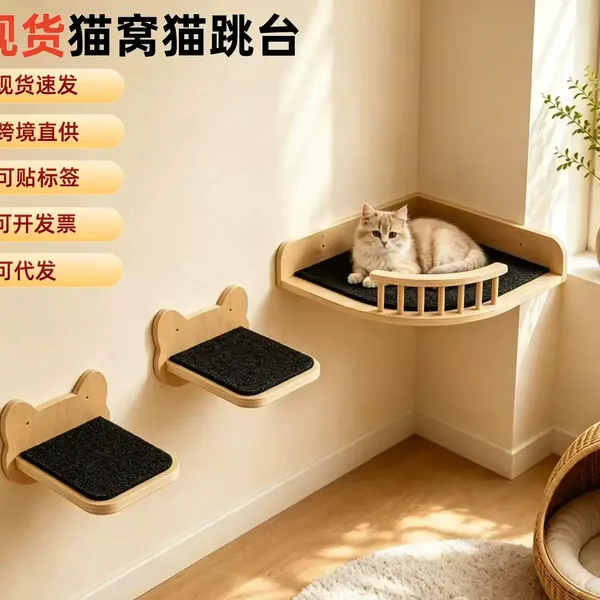
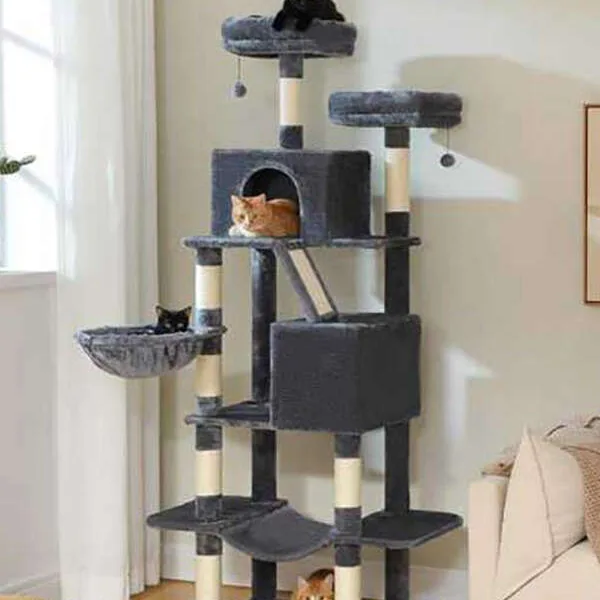
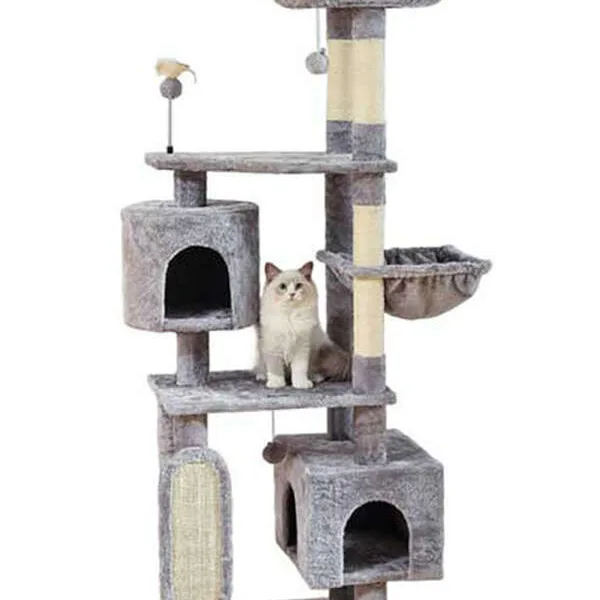
From our product catalogue
Real products we manufacture — sizes and options are on the product page.
Buying checklist
- Size for the adult weight (up to ~9 kg male), not the kitten — Ragdolls fill out until about three years
- At least two platforms with a 45 cm or longer short side; check both dimensions, not just area
- Ask for platform board thickness and whether the platform has support under its centre
- Keep level spacing to 30–35 cm; a tall tower with 50 cm gaps will only be used at the bottom
- One flat berth plus one deep cradle — shallow bowls get refused by cats that sleep on their backs
- Confirm the carton is sized by the platform panel; it, not weight, caps units per 40HQ
FAQ
How big should a cat tree be for a Ragdoll?
Bigger than the cat looks, and sized for the adult rather than the cat you are looking at. An adult Ragdoll lying flat measures roughly 45 cm from nose to tail base, so the realistic minimum is a platform of about 45 × 45 cm on at least two levels, with 55 × 45 cm being genuinely comfortable. Weight matters less than most people expect for comfort, but it matters a great deal for structure: males commonly reach 6.8–9 kg, and they keep growing until around three years old, so a tree bought for a 4.5 kg one-year-old may be undersized within eighteen months. Height is the least important dimension — a stable 110 cm tower with large platforms gets far more use than a 170 cm tower with small ones.
Why does my Ragdoll hang off the platforms instead of lying on them?
Because the platforms are too small for a cat that relaxes by extending rather than curling. A Ragdoll lying across a 30 cm platform leaves about 15 cm of body unsupported, and it will simply let that part hang rather than tuck in — which is fine for the cat and hard on the furniture. The load moves to the platform edge and stays there for hours, so thin boards bow and rear-edge screws work loose over months rather than failing at once. The practical fixes are a platform at least 45 cm on the side the body lies along, and a platform with support under its centre rather than screws only at the rear edge. If you cannot change the furniture, the cheapest improvement is to add a rigid flat board over the existing platform.
Do Ragdolls need a different cat tree from Maine Coons?
Yes, and the difference is shape rather than size. A Maine Coon is longer and taller and needs a wider platform, a heavier base and a large post diameter, because it is an active cat that lands hard on the top level. A Ragdoll is heavier per centimetre but lower and slower, so the binding constraint is platform depth and sustained edge load, not impact resistance — and because Ragdolls jump less willingly, layout matters more than height: 30–35 cm steps and large berths at 90–110 cm will be used, while a top perch at 170 cm usually will not. If you stock one large-cat model for both breeds, the Ragdoll side of the compromise is the one to protect: keep the platforms large and the steps close together.
Building a large-cat model for Ragdoll households?
Tell us the platform size you want, the adult design weight, and whether the unit has to survive being sold as a kitten tree that outlives the kitten. We will come back with the models in our range with platform dimensions, board thickness, support type and carton data, so you can check the loading maths before the order rather than after the first season of returns.
See the rangeFloor to Ceiling Cat Tree: What to Check Before You BuyWall Mounted Cat Shelves: Load Ratings, Fixings and LayoutCat Tree for a Maine Coon: Sizing Rules That Actually WorkCat Tree for Multiple Cats: Sizing for Two, Three or MoreSisal Cat Tree Posts: What Actually Determines How Long They LastHow Tall Should a Cat Tree Be? A Practical Guide