Cat Tree for Large Cats: The Numbers That Actually Keep It Upright
Most listings solve this problem by making the tower taller. Height is not what a big cat needs — load path is. A 10 kg cat jumping off a window sill puts a brief load into the top platform several times its own weight, and everything below it has to carry that.
Why "extra large" listings still wobble
A cat tree fails in one of two ways. It tips over, or it shakes. Both are decided by geometry, not by how heavy the box is.
Tipping is a lever problem. The load sits high, and the base resists. The taller the top platform and the narrower the footprint, the less sideways force it takes to start the whole tower rotating. A model can be genuinely strong and still tip, because strength is not the same as stability.
Shaking comes from joints: the connector between two posts, the point where a post meets a platform, and the thickness of the platform board itself. A large cat lands, the top platform flexes, the flex travels into the connector bolts, and after a few months the bolts have opened the holes slightly. From then on the tower is permanently loose.
The dimensions that decide whether it works
Ask for these figures per model rather than trusting a size label. The ranges below are typical for pet furniture built for adult cats in the upper weight bands; confirm actual values with the supplier, since they change per design.
| Cat weight | Platform size | Post diameter | Base footprint vs top platform | Risk if undersized |
|---|---|---|---|---|
| up to 5 kg | 30 cm square and up | 8 cm | base roughly 1.2× the platform area | Little — this is the standard build |
| 5–8 kg | 35–40 cm square | 9–10 cm | base at least 1.4× the platform area | Platform too small to lie on; cat uses the top edge and the tower leans |
| 8–12 kg | 45 cm square and up, or a full-length bed | 10 cm or more, solid core | base at least 1.5–1.8× the platform area | Visible flex on landing; connectors work loose within months |
| Maine Coon / very long body | Platform must be long, not just wide | 10 cm or more | same ratio, plus low centre of gravity | Cat cannot curl up; the body overhangs and the load is off-centre |
Post diameter and core, not just wrapping
On large models the post is a structural part, not a scratching accessory. A thin post wrapped in thick sisal looks substantial and behaves like a stick. Ask whether the core is solid board or a hollow tube, and what the wall thickness is.
The same post then has to survive scratching. A heavy cat tears sisal faster, so replacement posts matter more in this weight band than in any other. If the design does not allow a post to be replaced without dismantling the tower, the product has a fixed service life decided by its cheapest part.
Where large models usually break first
- Hammock stitching. The fabric is fine; the seam and the attachment points take the load. Look for a reinforced hem and metal rings rather than fabric loops.
- Connector bolts through particle board. Repeated load opens the holes. Threaded inserts or metal brackets at the highest-stress joints are the difference between two years and two months.
- Thin platform boards. A 12 mm board with a big span flexes. Thicker board, or a smaller span, or a support underneath.
- The base panel. It is the part nobody photographs. Enquire about its thickness and whether it is one piece or joined.
What to specify before you order in volume
For a retail programme aimed at large-cat owners, four specifications do most of the work: a platform minimum size written into the spec sheet, a post diameter and core type, a tested load per platform, and a stated base footprint. Everything else is styling.
The tested load figure is the one worth insisting on. A supplier who has tested the model can quote a number and describe the test. A supplier who has not will answer with adjectives. If no figure exists yet, it is reasonable to ask for a simple static load test on the top platform before the first bulk order — it is cheap, and it settles the argument with your own customers.
Freight: the hidden penalty on large models
Large cat trees are volume, not weight. A model can be priced attractively per unit and still lose money on landed cost because the cartons are long and the packing density is poor. Request carton dimensions, units per carton and units per 40HQ for the specific model — a general "we load many units" claim is not a loading plan.
Knock-down flat packing with protected corners is normal in this category. Assembled shipping almost never pays for itself on oversized models.
From our product catalogue
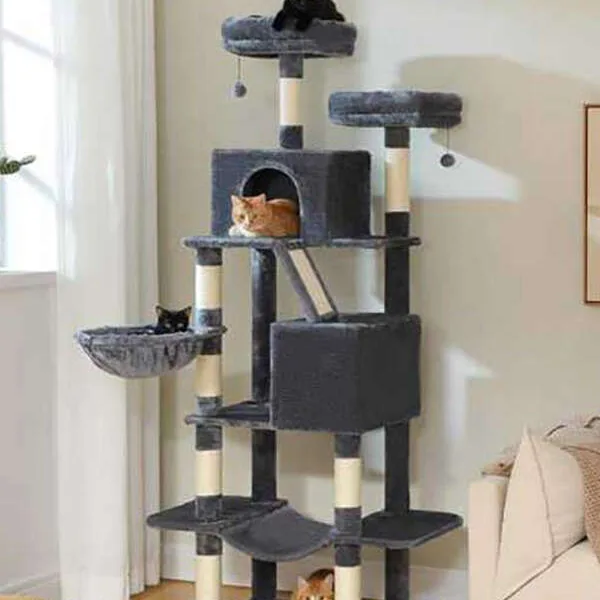
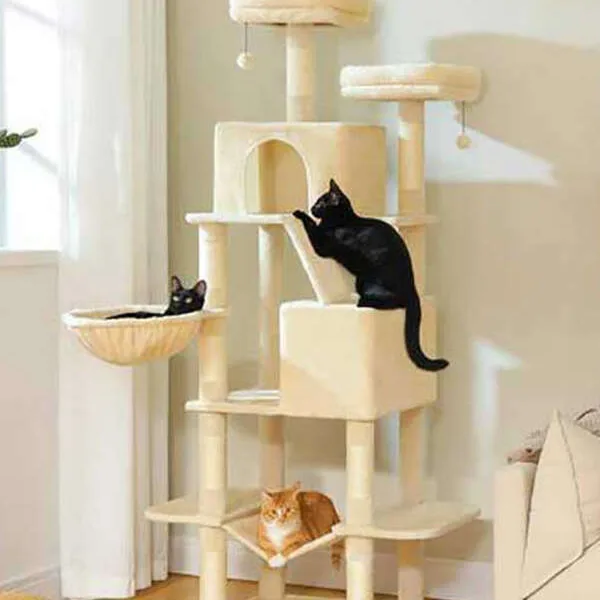
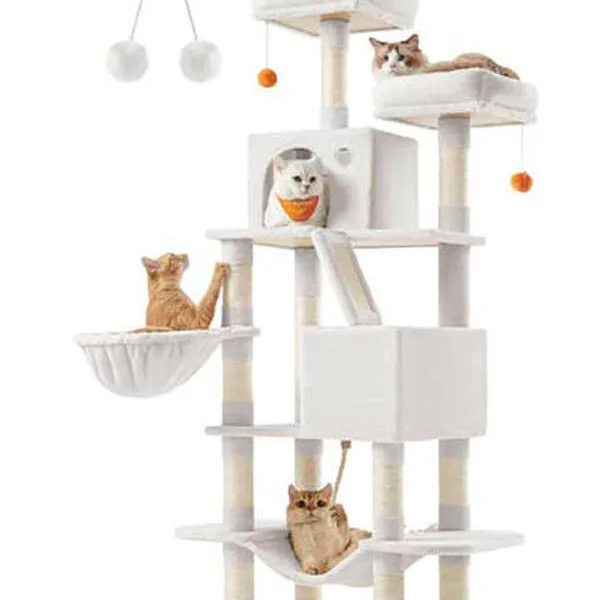
Real products we manufacture — sizes and options are on the product page.
Buying checklist
- Platform minimum size stated in the spec sheet, not just a size label
- Post diameter and core type (solid or hollow) confirmed
- Base footprint measured against top platform area
- Tested load per platform requested in writing
- Hammock and joint construction checked at the highest-stress points
- Carton dimensions and units per 40HQ confirmed for the specific model
FAQ
How big should a cat tree be for a large cat?
Look at platform size and base footprint before height. A cat over 8 kg needs a platform around 45 cm or larger to lie on, and a base footprint at least one and a half times the platform area to stay stable. A tall tower with small platforms gives a large cat nowhere comfortable to settle, so it ends up on the top edge — which is exactly where the load is worst.
Is a heavier cat tree always more stable?
No. Stability depends on footprint, height and where the mass sits, so a heavy tower with a narrow base can tip more easily than a lighter one with a wide base and a low first platform. Weight helps only when it is low and spread out.
Will a large cat break a standard cat tree?
Usually not immediately. The typical failure is progressive: the platform flexes, the connector holes open slightly, and the tower becomes loose over months. Models with metal brackets or threaded inserts at the joints, and thicker platform boards, hold up far better under sustained load.
Sourcing large-cat models for retail?
We build cat trees and pet furniture in Ningbo and quote large models with platform sizes, post specification, tested load figures and container loading attached, so you can compare landed cost instead of headline price.
See the rangeFloor to Ceiling Cat Tree: What to Check Before You BuyWall Mounted Cat Shelves: Load Ratings, Fixings and LayoutCat Tree for a Maine Coon: Sizing Rules That Actually WorkCat Tree for Multiple Cats: Sizing for Two, Three or MoreSisal Cat Tree Posts: What Actually Determines How Long They LastHow Tall Should a Cat Tree Be? A Practical Guide