Cat Tree for a Bengal: A Route to Run, Not a Tower to Sit On
A Bengal does not settle on the top platform. It goes up one side, crosses the top, comes down the other side, and starts again — so what you are buying is not a perch, it is a continuous path. Break one link in that path and the cat does not use 80% of the tower; it uses none of the upper half, and it is on your kitchen worktop instead.
Why this is a routing problem, not a weight problem
Start with what a Bengal is not. At roughly 4–7 kg for an adult, it is not a heavyweight, so the platform thickness and base-area arguments that dominate Maine Coon or Ragdoll buying do not decide the sale here. What a Bengal brings instead is muscle, acceleration and a preference for movement over rest: it treats vertical furniture as terrain to be crossed at speed, and it will cross the same terrain dozens of times a day if the exits and entrances line up.
That produces two failure modes that a spec sheet never mentions:
- A route with a break is abandoned, not partially used. If level four is reachable only by a 55 cm leap with no run-up, or its landing platform is too small to land on cleanly, the cat does not struggle upward — it stops at level three and writes off everything above. The upper platforms then look like design, but they are decoration.
- Unused height is not neutral. Every centimetre of tower that gets no traffic is still mass and still sail area, sitting above a base sized for a cat that never goes up there. Tall-and-abandoned is the worst combination: the tip-over exposure of a 170 cm unit with the wear pattern of a 90 cm one.
So the useful question is not "how tall" or "how much load" — it is "can a 7 kg cat move through this thing in a loop, at speed, without a single move it has to think about?".
The route audit: five measurements, one tape measure
These are the checks we run on a layout before quoting a Bengal-oriented model. All of them are geometric, all of them can be verified on a sample in the showroom or on a drawing, and none of them require a test report:
| Check | What to measure | Target | If it is off |
|---|---|---|---|
| Rise per step | Vertical distance between two adjacent usable levels | 30–40 cm | Above 50 cm the route splits into two disconnected zones; the upper one loses traffic |
| Run before the rise | Flat depth available to stand on before each jump | ≥ 25 cm | No launch pad = every climb becomes a vertical haul on the post, and most cats decline it |
| Landing size | Short side of the platform the cat lands on | ≥ 30 cm (35 cm better) | Half-landings get used once, then avoided; the cat drops to the floor instead |
| Dead ends | Levels with only one way in or out | 0 on the main path | A dead end on a fast cat becomes an ambush point and a traffic jam, and the loop stops being a loop |
| Head clearance above the top perch | Free height from the top platform to the ceiling or shelf | ≥ 40 cm | The cat cannot sit upright, so the perch is used for transit only — and stops being a resting place |
Two more worth adding to the drawing, because they are the ones factories quietly economise on: post wrap diameter (10 cm or more — a large paw on an 8 cm post loses its grip and the cat stops scratching it) and base footprint against total height (roughly 1:2.5 for freestanding units, or a wall strap in the box).
Same height, different route: what the extra levels actually cost
Here is the trade-off in numbers, using one 160 cm unit as the example. The two versions share the base, the posts, the tooling and the outer height; only the platform count and spacing change. This is arithmetic on the panel dimensions, not a test result — but it is enough to see where the money goes:
| Metric | Typical 3-platform tower | 6-platform route | Change |
|---|---|---|---|
| Platforms (W × D) | 3 × 40 × 40 cm | 6 × 35 × 35 cm | +3 platforms |
| Rise per step | ≈ 55 cm | ≈ 32 cm | −23 cm, inside the step range |
| Transitions in the path | 3 | 6 | More ways to move, fewer single points of refusal |
| Board area consumed | 0.48 m² | 0.74 m² | +53% |
| Added board mass at 15 mm | — | — | ≈ +2.5–3 kg per unit |
| Climbing distance per lap | ≈ 1.6 m vertical | ≈ 2.9 m including the horizontal moves | ≈ +80% traffic per lap |
| Assembly | 3 platforms, 3 fixing points | 6 platforms, 6 fixing points | More screws, more assembly minutes, bigger instruction sheet |
Read the last three rows together, because they are the whole commercial argument. Doubling the route costs about half again in board, adds a couple of kilos to the unit, and adds fixing time at the packing line. What it buys is a layout that a high-traffic cat walks as a loop instead of inspecting once. For an importer, that difference usually shows up as fewer "my cat won't use it" returns — a category of complaint that no warranty claim ever captures, and that rarely gets measured because the unit is not defective, it is just wrong.
If the base can stay the same, this is the cheapest kind of model change a factory can run: no new tooling, no new carton length, same posts. Ask whether the extra platform panels change the carton count or the carton height, because that is where the container maths moves even when the footprint does not.
Where Bengal-owned units actually fail
The wear pattern on high-traffic furniture is different from the wear pattern on furniture that gets sat on:
- Joints, not boards. A cat that lies down loads one platform for hours. A cat that circuits loads every joint, repeatedly, from changing directions. The screws that hold a platform at its rear edge only are the first thing to loosen, and the early symptom is a platform that rocks by a few millimetres — which the cat notices long before the owner does, and which is often why a previously used level goes quiet.
- Sisal wear is a consumable, not a defect. A post that is climbed and scratched dozens of times a day will go bald at one height first. If the post cannot be replaced or re-wrapped, the whole unit's useful life is set by one sleeve of rope.
- Descent is harder on the unit than ascent. Coming down a 160 cm route at speed puts a landing load on the lower platforms that is well above the cat's static weight. We design for a landing allowance of about two to three times static weight; that is a design assumption, not something we will present as a measured value, and it is worth asking any supplier what allowance they use.
What to put on the purchase order
- Design weight — 7 kg adult, plus a stated landing allowance. Both, in writing.
- Transitions — at least five on the main path, with the rise per step between 30 and 40 cm.
- Run depth — 25 cm or more of flat standing space before every rise.
- Landings — minimum 30 cm on the short side, and at least two at 35 cm or more.
- No dead ends on the main loop, plus 40 cm clearance above the top perch.
- Post wrap — 10 cm diameter or more, and replaceable.
From our product catalogue
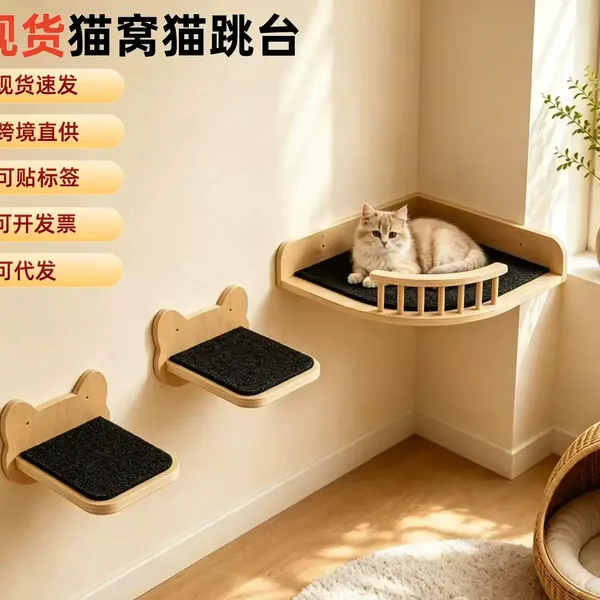
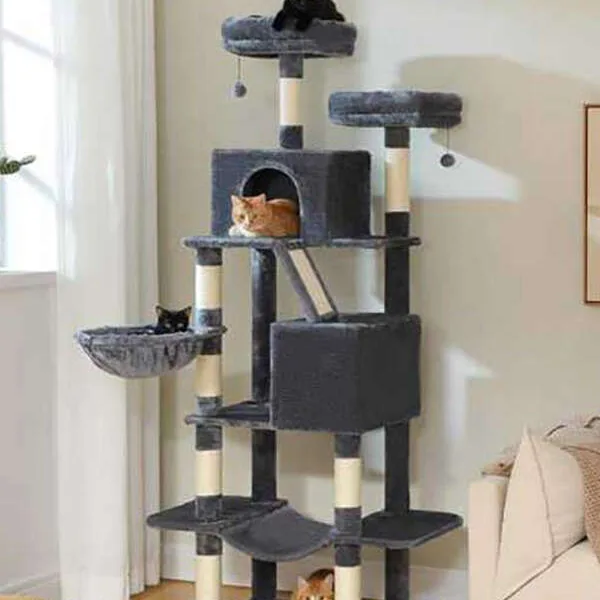
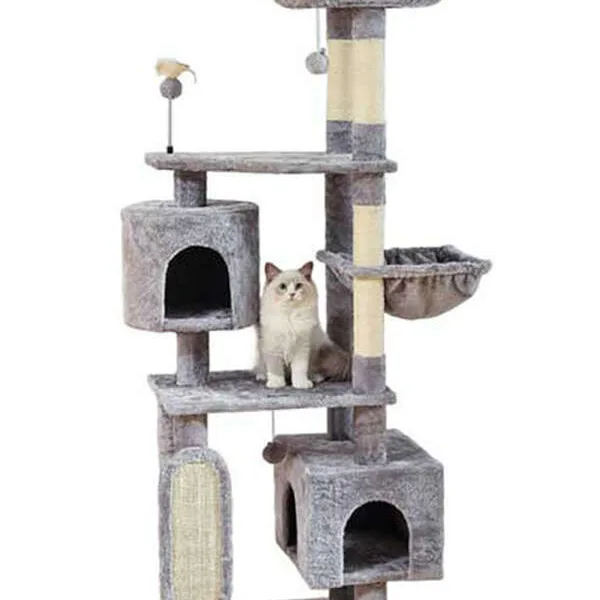
Real products we manufacture — sizes and options are on the product page.
Buying checklist
- Audit the route, not the height: count transitions and measure the rise between levels (30–40 cm)
- Check there is at least 25 cm of flat run before every rise — no launch pad, no climbing
- Landing platforms at 30 cm minimum on the short side, at least two at 35 cm or more
- Zero dead ends on the main loop, and 40 cm of clearance above the top perch
- Post wrap 10 cm or more in diameter, and replaceable — sisal is a consumable on a Bengal
- Confirm whether extra platform panels change carton count or height before fixing the loading plan
FAQ
Will a cat tree alone keep a Bengal busy, or do I need wall shelves too?
Usually both, and the reason is routing rather than space. A Bengal needs a continuous circuit more than it needs a single tall object, and a freestanding tower can only offer a loop if it has two usable sides — up one way and down another. Most towers are built as a one-sided climb with platforms stacked above the same footprint, which is a ladder, not a circuit. Wall shelves plus a tower at the end of the run give the cat a genuine loop through the room, and they also let you keep the route continuous at heights where a freestanding unit would become unstable. If you can only buy one thing, buy the tower with the most transitions and the largest landings, and place it so the cat can get off at the top onto something else.
How tall should a Bengal's cat tree be?
Height is the least useful number, and buying by it is how people end up with a 170 cm tower that gets used to 90 cm. What matters is whether the path is continuous: a 140–160 cm unit with five or six transitions, 30–40 cm rises and landings of 30 cm or more will be used far more than a 180 cm unit with three platforms and 55 cm gaps. There are two practical ceilings. The first is stability — a freestanding unit much above 1.6 m needs a wider base or a wall strap, and an unused tall tower is pure tip-over risk. The second is the room: the top perch needs about 40 cm of clearance above it, or the cat cannot sit up there and the level becomes transit only.
Why does my Bengal ignore the top half of the cat tree?
Almost always one of four geometric faults, and all four are visible with a tape measure. The rise to the next level is too big — over about 50 cm, most cats want a run-up they do not have, so the climb stops. The landing is too small, so the cat arrives half-off the platform and does not repeat the move. There is no flat run before the jump, so every ascent is a vertical haul on the post. Or the top level is a dead end with nothing to get onto, which makes it a trap rather than a vantage point. Fixing it is usually cheaper than replacing the unit: add an intermediate platform, bolt a wider board onto the existing one, or bridge the top level to a shelf or window sill so the route continues instead of stopping.
Reworking a tower into a route for high-energy cats?
Send us the height, the footprint and how many platforms you want, and we will come back with the platform dimensions, rise per step, board thickness, fixing method and carton data for models in our range — so you can check the route and the container maths on paper before the order, not after the first season of returns.
See the rangeFloor to Ceiling Cat Tree: What to Check Before You BuyWall Mounted Cat Shelves: Load Ratings, Fixings and LayoutCat Tree for a Maine Coon: Sizing Rules That Actually WorkCat Tree for Multiple Cats: Sizing for Two, Three or MoreSisal Cat Tree Posts: What Actually Determines How Long They LastHow Tall Should a Cat Tree Be? A Practical Guide