Cat Tree Container Loading: The Maths That Decides Your Landed Cost
Cat trees are the worst possible cargo for a container: light, bulky, and packed in long flat cartons that lose you a layer at the top. The fill rate decides your freight cost per unit, and the fill rate is decided months earlier by the carton design.
Freight is charged on the container, so fill rate is your real unit cost
On a full container you pay the same ocean freight for 320 sets as for 375 sets. The difference between those two numbers is not a rounding error — it is a straight percentage added to the landed cost of every unit, because the freight bill is spread across fewer pieces. This is why cat tree sourcing so often goes wrong at the arithmetic stage rather than the negotiation stage: buyers compare unit prices from two factories, then load one of them badly.
Two volumes matter, and they are not the same number. Nominal volume is the container's internal capacity. Usable volume is what you can actually pack solid goods into after the floor battens, the door end, the roof camber and the fact that cartons do not tessellate. The gap between them is where optimistic quotations live.
Usable cubic metres by container type
| Container | Internal volume (nominal) | Realistic usable for flat-packed furniture | Payload reference | Where cat trees usually stop |
|---|---|---|---|---|
| 20GP | ≈ 33 m³ | ≈ 25–27 m³ | ≈ 28 t | Volume, never weight |
| 40GP | ≈ 67 m³ | ≈ 55–58 m³ | ≈ 28 t | Volume |
| 40HQ | ≈ 76 m³ | ≈ 62–66 m³ | ≈ 28 t | Volume |
| 45HQ | ≈ 86 m³ | ≈ 70–74 m³ | ≈ 27 t | Volume, plus road-legal limits at destination |
The usable band above assumes cartons that stack reasonably: regular box shapes, no awkward protrusions, and a full container load. Drop to the lower end of the band for towers packed in long cartons over about 1.2 m, and ask your forwarder for a loading plan rather than a capacity figure. A 40HQ quoted at 76 m³ of cat trees is not a plan, it is a label on the side of the box.
Why the top layer is the expensive one
A container is 2.39 m wide internally, and cartons are designed to fit that width. Height is where the loss hides. Container internal height is roughly 2.39 m for a standard GP and 2.69 m for a high cube, so a carton stack of, say, 0.52 m can only go four high in a GP (2.08 m) leaving about 30 cm of dead air across the whole floor — roughly an eighth of the container's height that you are paying for and not using.
| Carton stackable height | Layers in 20GP (2.39 m) | Wasted height | Layers in 40HQ (2.69 m) | Wasted height |
|---|---|---|---|---|
| 0.40 m | 5 (2.00 m) | 0.39 m ≈ 16% | 6 (2.40 m) | 0.29 m ≈ 11% |
| 0.52 m | 4 (2.08 m) | 0.31 m ≈ 13% | 5 (2.60 m) | 0.09 m ≈ 3% |
| 0.66 m | 3 (1.98 m) | 0.41 m ≈ 17% | 4 (2.64 m) | 0.05 m ≈ 2% |
| 0.88 m | 2 (1.76 m) | 0.63 m ≈ 26% | 3 (2.64 m) | 0.05 m ≈ 2% |
Read the last row carefully: a carton 88 cm tall wastes a quarter of a 20GP but fills a high cube almost perfectly. That is the single most useful carton-vs-container decision in this category, and it is made by the factory's packaging engineer, not by the forwarder. If your supplier only offers one carton size for every model, you are almost certainly shipping air.
Sets versus cartons versus pieces
Most cat trees ship as two or three cartons per set, because the posts and platforms will not fit in one box without making the carton unmanageable. Container plans quoted in "cartons" hide this; plans quoted in "sets" do not. Always convert to the unit you actually sell in before comparing suppliers.
For palletised loads the number drops again, because a pallet footprint consumes floor space that no carton occupies. Palletising protects the goods and speeds unloading, and it costs you roughly 8–12 per cent of the fill. That trade is worth having deliberately, not by accident.
The four carton facts to get in writing before you book
- Carton dimensions per carton — length, width, height, in centimetres, for every carton in the set. "Standard export carton" is not a dimension.
- Cartons per set — so the maths converts to saleable units.
- Gross weight per carton — needed to confirm the load stays under payload and to price any destination handling.
- Stack height limit — whether the carton can be stacked six high or only three, which changes the whole plan and cannot be guessed from the box.
These four lines on a single spreadsheet page turn a vague quotation into a loading plan. Any factory that cannot produce them before you order is telling you something about what happens when there is a problem after the order.
Loading loss is a design decision, taken early
Flat-pack engineering reduces volume by splitting a tower into panels, but it adds hardware bags, assembly instructions and extra carton board. Too much disassembly and the carton count grows faster than the volume falls, and hand-labour cost rises. The practical optimisation is usually a two-carton set for towers and a single flat carton for wall-shelf sets, with carton heights chosen against the container height rather than against the product's natural shape.
This is why carton planning belongs in the quotation, not in the shipping week. Once the carton is designed, printed and approved, changing its height means new board, new artwork and a new plate — the most expensive possible moment to discover you are shipping 26 per cent air.
What we do not publish
We do not publish cubic metres per model, carton counts or loading quantities on this page, because they differ by model, by hardware set and by the destination's packaging preferences, and a published number that turns out to be wrong is worse than a question you had to ask. What we do instead: for any model you are considering, we send the four carton facts above plus a loading plan for the container type you intend to book, in writing, before you commit to the order.
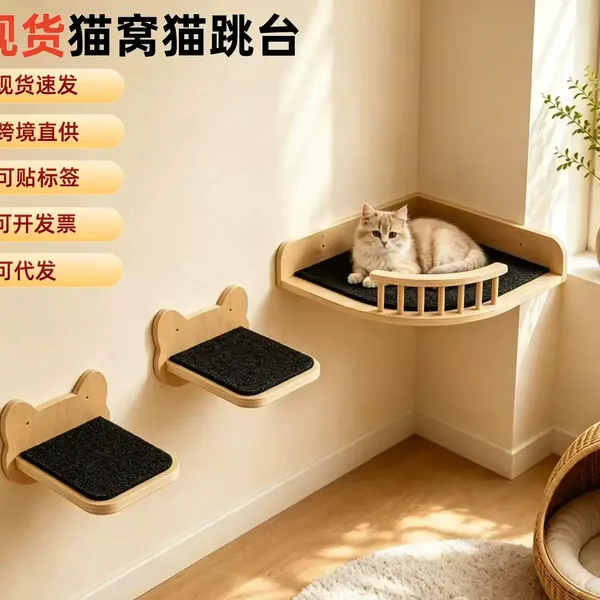
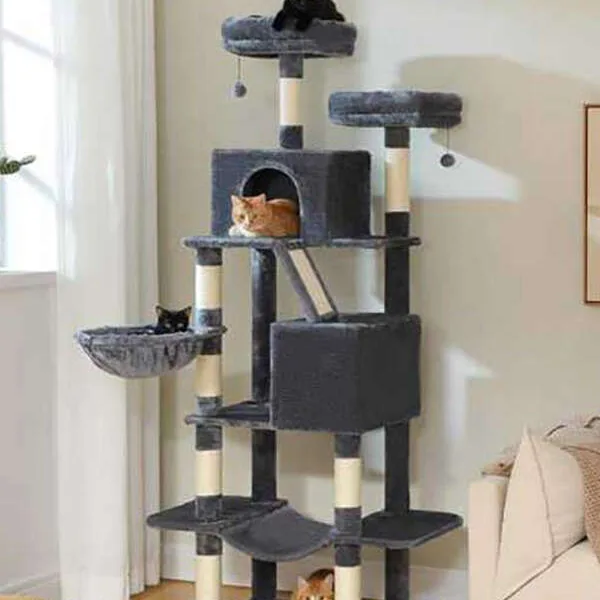
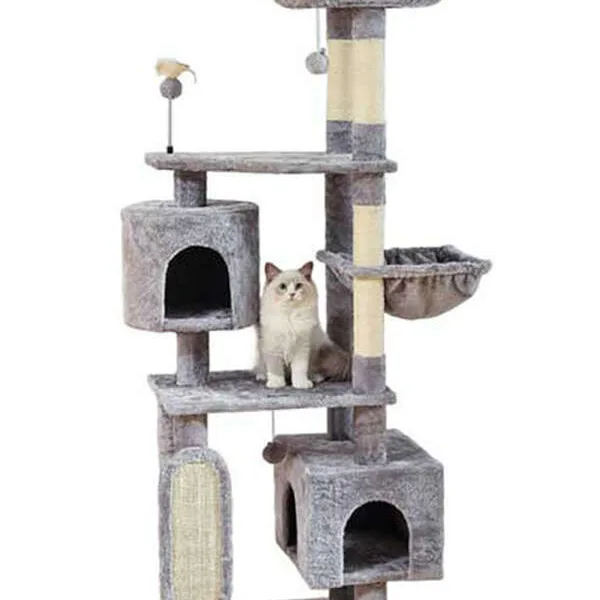
From our product catalogue
Real products we manufacture — sizes and options are on the product page.
Buying checklist
- Carton dimensions (L×W×H in cm) received in writing for every carton in the set
- Cartons per set known, so loading maths converts to saleable units
- Gross weight per carton known and checked against container payload
- Stack height limit confirmed — determines the layer count and the loss
- Carton height checked against container internal height, not against the product shape
- Loading plan requested for the specific container type being booked
- Palletisation decision taken deliberately, with its 8–12% fill cost counted
FAQ
How many cat trees fit in a 40HQ container?
It is driven by cubic metres per set, not by a unit count. A 40HQ has about 76 m³ nominal and roughly 62–66 m³ usable for flat-packed furniture. Divide usable volume by the cubic metres per set from your own carton dimensions, then subtract for the top layer and the door end — typically another 8–12 per cent. For a two-carton set totalling 0.17 m³ that lands around 330–345 sets rather than the 376 you get from a straight division. Ask for the loading plan, not the arithmetic.
Why does carton height matter more than carton width for container fill?
Because a container holds whole layers, not fractions of one. A carton 88 cm tall only goes two high in a 2.39 m standard container, wasting about a quarter of the height, but three high in a 2.69 m high cube, wasting almost nothing. Two factories can quote the same carton volume per set and get very different fill rates on the same booking, purely from how the height divides into the container.
Should cat trees be shipped palletised or floor-loaded?
Floor loading gives the highest fill and the lowest freight per unit, but unloading is slower and the cartons take the handling damage. Palletising costs roughly 8–12 per cent of the fill because the pallet footprints consume floor space no carton can use, and it protects the goods and speeds up unloading and inspection at the destination. For retail distribution pallets are usually worth it; for a full direct container to one warehouse, floor loading usually wins. Decide it before the cartons are designed, not at the port.
Need a loading plan before you book?
Send us the models you are considering and the container type you intend to book. We will come back with carton dimensions, cartons per set, gross weights and a loading plan in sets — the figures you need to quote a real landed cost before you commit.
See the rangeFloor to Ceiling Cat Tree: What to Check Before You BuyWall Mounted Cat Shelves: Load Ratings, Fixings and LayoutCat Tree for a Maine Coon: Sizing Rules That Actually WorkCat Tree for Multiple Cats: Sizing for Two, Three or MoreSisal Cat Tree Posts: What Actually Determines How Long They LastHow Tall Should a Cat Tree Be? A Practical Guide