Dog Bed for Large Dogs: the Load Is Not Where You Think It Is
Most "large dog" beds are the same construction drawn wider. The problem is not that a big dog weighs more per square centimetre — it barely does. It is that the same compression takes away twice the millimetres, and the total load lands on seams, zip and base panel that were sized for a spaniel.
"Large" is a floor-area and depth claim, not a weight class
A 60 cm pet bed and a 110 cm one are usually the same recipe: a cover over a fibre or foam pad. The difference is that the big one has to hold a body that is roughly twice as long, and the failure modes move. Small beds fail by being outgrown. Large beds fail by going flat under the hips, by the zip splitting, or by the cover stretching until the fill migrates to one end.
So the useful way to specify a large-dog bed is not "rated for 40 kg" — hardly any supplier can defend that number — but by three measurable things: the load the sleeping surface sees, the thickness of foam left under the dog, and the volume the bed occupies in a carton. Those three decide comfort, returns and freight, in that order.
Load per square centimetre barely changes with dog size
This is the part buyers usually get backwards. Pressure is mass times gravity divided by contact area, and a bigger dog also spreads over a bigger area, so the two grow together and largely cancel. The table below assumes the effective contact patch is about 55% of the dog's lying silhouette (legs tucked, gaps under the belly excluded). Change that assumption and every figure moves down or up together — the shape of the result stays the same.
| Dog weight | Lying silhouette, L × W | Effective contact at 55% | Pressure on the bed |
|---|---|---|---|
| 10 kg | about 40 × 22 cm | about 480 cm² | about 2.0 kPa |
| 25 kg | about 60 × 30 cm | about 990 cm² | about 2.5 kPa |
| 40 kg | about 75 × 38 cm | about 1,570 cm² | about 2.5 kPa |
| 55 kg | about 88 × 45 cm | about 2,180 cm² | about 2.5 kPa |
| 70 kg | about 100 × 50 cm | about 2,750 cm² | about 2.5 kPa |
What the table says is that a 70 kg dog presses about as hard per cm² as a 25 kg one. Two things do change, and both are what the customer complains about. First, the absolute deflection: at the same compression percentage, the deeper body removes more millimetres of clearance. Second, the total force on the parts that carry the whole animal — the seam, the zip, the base panel and the cover — which rises roughly in step with weight, so it is nearly three times higher at 70 kg than at 25 kg.
Collapse is a millimetre question, not a firmness question
Work it in thickness rather than in adjectives. An 8 cm pad that compresses 60% under a sleeping dog leaves 3.2 cm of foam under the hip. A 12 cm pad at the same 60% leaves 4.8 cm. The dog is not judging "firm" or "soft"; it is judging whether bone reaches the floor, and that is a single subtraction.
Which is why a thin, very firm pad is often worse for a heavy dog than a thick, medium one: firmness changes how far it compresses, thickness decides how much there was to lose. Foam also takes compression set — the percentage of thickness it fails to recover after being loaded and left — which is what turns a bed that felt right in the shop into a flat mat in six weeks. It is measured, not guessed, and the supplier either has the figure for that foam or does not.
The three numbers worth writing into a spec are density in kg/m³, indentation force deflection at 25% and at 65% compression (ASTM D3574 or ISO 2439 are the usual methods), and compression set. Density alone is not support: two foams at 25 kg/m³ can differ by a factor of two in how hard they push back.
What carries the total load
- Seam. The long seam of a rectangular bed takes the full body load in tension every time the dog settles. Double-stitched with a bonded thread is the minimum; a single row on a 70 kg bed is a scheduled failure.
- Zip. A removable cover needs one, and the slider is the weak point on a curved run. Nylon coil tolerates repeated loading better than moulded teeth; ask for the pull strength on the slider rather than the tooth size.
- Base panel. At 60–70 kg a smooth base slides on tile and the dog lands half off the bed. Specify the base material by name — a coated oxford or a dotted non-slip — not as "anti-slip".
- Cover stretch. Knitted plush relaxes with use; a cover cut exactly to the pad looks baggy after a month. A small negative allowance at cut, or a woven face, holds shape.
The carton decides the landed cost
Beds are light and bulky, so freight is charged on volume, not mass. Air and express use a volumetric divisor (6,000 for most air freight, 5,000 for many express tariffs); sea LCL is charged straight on cubic metres, and a 40 ft high cube takes roughly 68 m³ of usable space. The same bed that costs a few dollars of foam can cost several times that to move.
| Bed size | Packed carton | Volume | Volumetric weight at 6,000 | Actual weight | Pieces in a 40HQ at 68 m³ |
|---|---|---|---|---|---|
| Small | 55 × 35 × 18 cm | 0.035 m³ | 5.8 kg | about 2.2 kg | about 1,960 |
| Medium | 70 × 50 × 22 cm | 0.077 m³ | 12.8 kg | about 3.8 kg | about 880 |
| Large | 90 × 65 × 25 cm | 0.146 m³ | 24.4 kg | about 5.5 kg | about 465 |
| X-large | 110 × 80 × 28 cm | 0.246 m³ | 41.1 kg | about 7.5 kg | about 276 |
| XX-large | 120 × 90 × 30 cm | 0.324 m³ | 54.0 kg | about 9.0 kg | about 210 |
Two conclusions follow. The volumetric weight of an XX-large bed is about six times its actual weight, so the freight quote is a carton quote — shaving 4 cm off the carton height beats shaving 300 g off the fill. And because pieces per container fall by a factor of nine from small to XX-large, the big sizes only work at retail prices that carry the volume, or compressed. Fibre-filled beds compress well and recover over a day or two; foam cores compress badly and recover slowly, which is the real reason vacuum packing and orthopaedic foam rarely appear in the same product.
What to put on the purchase order
- Inner sleeping dimensions for every size, next to the outer dimensions.
- Foam or fill thickness in mm, plus density in kg/m³ for foam or g/m² for fibre.
- IFD at 25% and 65% compression and compression set, quoted to a named test method.
- Seam construction: stitch rows and thread type on the load-bearing seam.
- Zip type, length and slider pull strength, if the cover is removable.
- Packed carton in cm and unit weight, so volumetric weight and container loading can be calculated before the order is placed.
From our product catalogue
Real products we manufacture — sizes and options are on the product page.


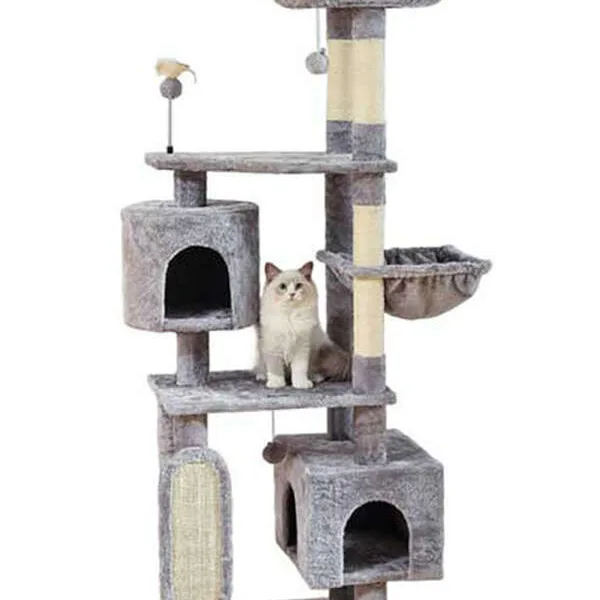
Buying checklist
- Inner dimensions stated for every size, not only the outer outline
- Fill thickness in mm, plus density in kg/m³ for foam or g/m² for fibre
- IFD at 25% and 65% compression and compression set, to a named test method
- Load-bearing seam described by stitch rows and thread type
- Zip type and slider pull strength given if the cover is removable
- Packed carton and unit weight, so volumetric weight can be checked before ordering
FAQ
What size bed does a 40 kg dog need?
Measure the dog rather than the breed: nose to the base of the tail standing, plus chest depth for the wall height. As a working rule, add about 15 cm to the body length for a dog that curls and 20–25 cm for one that stretches out, and give it at least 60 cm of usable inner floor on the long axis for a 40 kg animal. Two cautions. Most beds are sold on their outside size, so a 90 cm bed may only offer 70–75 cm of floor once the walls are counted — ask for the inner figure in writing. And a bed that is long enough but only 3–4 cm thick will still be abandoned, because the dog is choosing between the bed and the floor and the floor does not go flat.
How do I know the foam will not collapse before I order volume?
Ask for three figures on the actual foam, not the product family: density in kg/m³, indentation force deflection at 25% and at 65% compression, and compression set. Density alone tells you almost nothing about support — two foams at the same density can differ by roughly a factor of two in how firmly they push back, because density is mass per volume and IFD is the force needed to indent the surface. The 65% figure matters more than the 25% one for a heavy dog, because that is the region a large animal actually reaches. Compression set predicts whether the bed recovers after a night under the dog or stays dented. If a supplier quotes "high density foam" with no numbers and no test method, treat that as an unspecified part.
Can large dog beds be shipped compressed, and does the fill recover?
Fibre fill compresses well and recovers well, which is why most large beds ship vacuum-packed or roll-packed — typical recovery is a day or two, longer in a cold warehouse, and the recovery time belongs on the care label because that is what generates the "arrived flat" review. Foam cores are the opposite: a moulded foam block does not compress far, takes compression set if it is held compressed for weeks in a container, and may never come back to full thickness. That is why orthopaedic and foam-core beds normally ship at full loft in a big carton, and why their volumetric weight rather than their foam cost is what you negotiate. If you want both a compressed pack and a foam core, expect to ship the cover flat and the foam separately, and cost the two cartons.
Specifying a large-format bed for your market?
Our factory builds pet furniture and the padded surfaces that go with it — foam, fibre fill, covers, zips and the carton that carries them. Send the dog sizes you are targeting, the market and how you want it packed, and we will quote what we can actually make today with thickness, fill specification, zip type and carton dimensions in writing. If a dog-bed format is outside what we currently run, we will say so rather than quote around it.
See the range