Cat Bed for Large Cats: the Number on the Label Is the Wrong Number
Nearly every bed is sold on its outside diameter, because that is what fills the carton. The cat lies on the inside diameter, which is smaller by twice the wall — and that gap is where large-cat beds get returned.
Outer size sells the bed; inner size decides whether it is used
Take a typical round bolster bed listed at 60 cm. The bolster is built from a foam ring plus a cover, and each side eats 6–10 cm once you allow for the seam allowance and the padding that a cat's weight compresses. At 8 cm per side, the usable floor is 44 cm across. That is a reasonable bed for a 4 kg cat and a cramped one for anything over about 7 kg — yet both animals are sold the same "60 cm" product, because 60 cm is the dimension that determines the carton.
This is the cheapest thing an importer can fix at the specification stage. Ask for the inner dimension in writing, next to the outer dimension, and decide which one goes on the packaging. Retailers who print the inner size get fewer size-related returns, because the customer can finally measure the cat against a number that means something.
Posture sets the geometry, not the breed name
"Large cat" is not one shape. A 9 kg cat that sleeps stretched out on its side needs a long flat bed; a 9 kg cat that sleeps curled needs a circular one with a rim. Size for the wrong posture and you get a bed that is big enough on paper and unused in practice.
| Sleeping posture | Floor the cat uses | Bed that works | What goes wrong when undersized |
|---|---|---|---|
| Curled, nose to tail | About 40 cm across for an average adult; commonly 45–50 cm for a large male | Round or oval, raised rim | Cat perches on the rim instead of lying inside, or ignores the bed |
| Stretched on the side | About 55–65 cm long and 25–30 cm wide for a large cat | Oval or rectangular, flat or low rim | Head and hindquarters hang over both ends; the bed skids as the cat settles |
| Chin propped on a rim | Same floor as above, plus a rim 8–12 cm high at the head end | Bolster with a higher head end | A rim above roughly 15 cm blocks entry for a big cat; below that the head slips off |
| Flat out, belly up (warm rooms) | Around 55 × 40 cm of flat surface | Flat mat, no rim | Cat sleeps on the floor beside the bed instead |
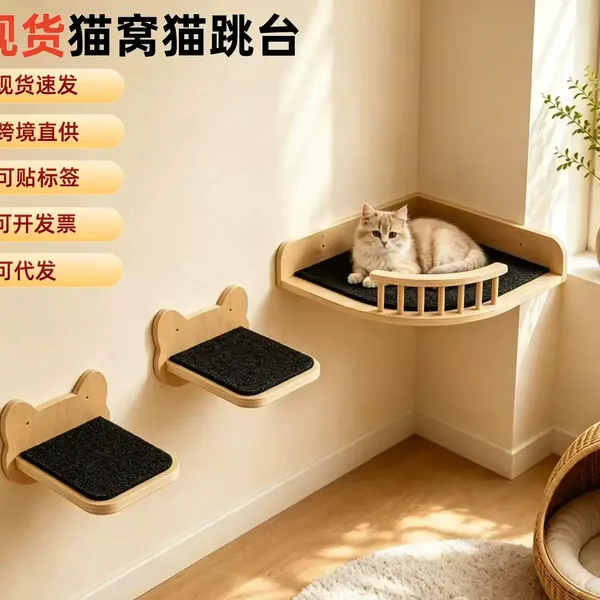
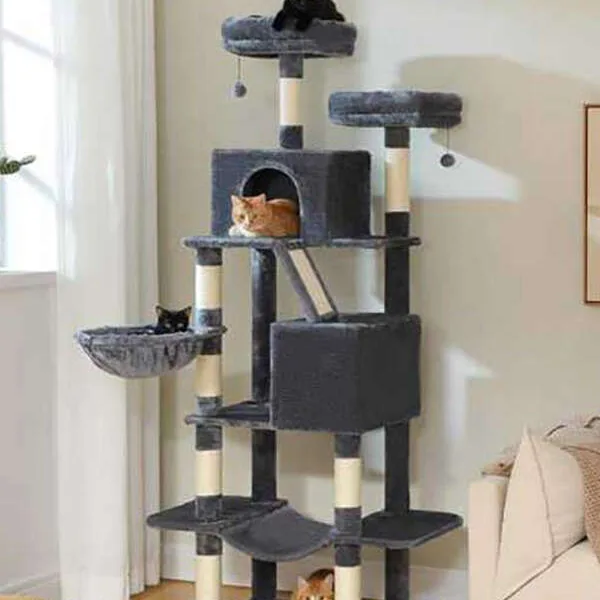
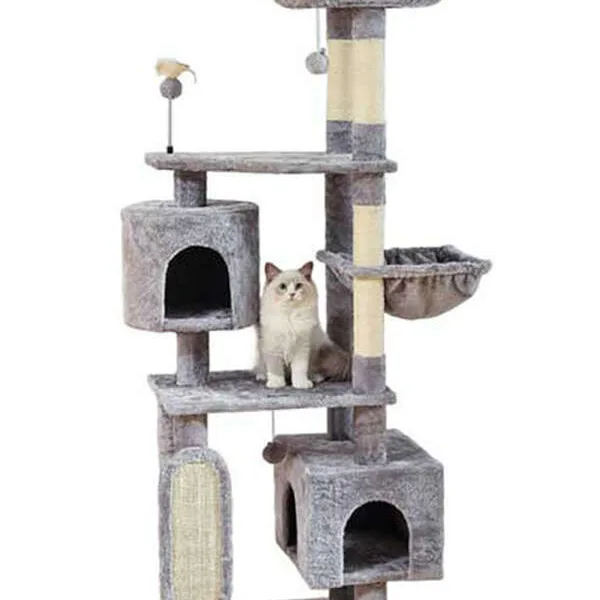
| Inside a condo or on a platform | The tray floor of that condo, not a bed dimension | Cushion cut to the tray | Cushion migrates into a corner and the cat wedges against the wall |
The arithmetic that explains most returns
The only figure on this page that is calculated rather than reported is the inner diameter: outer diameter minus twice the wall. The rest — body length, curled footprint — is commonly published breed data, not something we measured.
| Listed outer size | Wall and bolster, per side | Usable inner floor | Verdict for a 6–7 kg cat | Verdict for a 9–10 kg cat |
|---|---|---|---|---|
| 50 cm round | 8 cm | 34 cm | Cramped; usually ends up as a perch | No |
| 60 cm round | 8 cm | 44 cm | Works, curled | Marginal — curled only, no stretch |
| 70 cm round | 8 cm | 54 cm | Roomy | Works curled; still short for stretching |
| 80 cm round | 8 cm | 64 cm | Oversized, but fine | Works curled and half-stretched |
| 70 × 50 cm rectangular | 6 cm per side on the short axis | 58 × 38 cm | Best all-rounder | Good; the long axis is what a large cat uses |
Two practical consequences. First, a rectangular bed beats a round one of the same nominal size on a 9 kg cat, because the long axis is where the body goes. Second, past about 70 cm the carton cost climbs faster than the foam cost — the bed starts to ship as a bulky item, and volumetric weight rather than mass sets the freight.
Support is load per unit area, so a bigger bed helps twice
A 9 kg cat lying curled puts its weight on a contact patch far smaller than the bed itself. Loose fibre fill and thin foam compress to nothing under that, which is why so many large-cat beds go flat in the middle within weeks while the rim still looks new. The fix is structural rather than cosmetic: a foam block or baffled fibre that keeps its loft in the centre, and a stated density in kg/m³ on the spec sheet. A supplier who cannot state density and thickness has not specified the part that fails.
Packing is the other half of it. Fibre-filled beds are usually vacuum-compressed to a fraction of their lofted volume, which is what makes them economical to ship — and which produces the "arrived flat" review if the recovery time is not on the care label. Typical recovery runs from a day to two, longer in a cold warehouse. Put the recovery time and the packed-versus-lofted volume ratio on the label and most of that complaint disappears.
What to put on the purchase order
- Inner dimensions in cm, stated next to the outer dimensions, for every size in the range.
- Wall and bolster height as separate figures — a 20 cm wall and a 20 cm bolster are different products.
- Fill type and density (kg/m³ for foam, g/m² for fibre), with centre thickness before and after a stated settling period.
- Cover construction: removable or not, zip type, and the washing and drying conditions the shrinkage figure was measured at.
- Packed and lofted dimensions plus recovery time, so the freight maths and the care label come off the same sheet.
- Non-slip base material, named. A large cat landing on a bed that slides is the second complaint after size.
From our product catalogue
Real products we manufacture — sizes and options are on the product page.
Buying checklist
- Inner dimension in cm stated for every size, not just the outer
- Wall thickness and bolster height given as separate figures
- Fill type and density in kg/m³ or g/m², with centre thickness
- A rectangular option in the range — the long axis is what large cats use
- Packed and lofted dimensions plus recovery time on one sheet
- Non-slip base material named, not described as 'anti-slip'
FAQ
What size bed does a large cat actually need?
Measure the cat, not the breed. Take nose to the base of the tail with the cat standing, then add about 10 cm for a curled sleeper or 15–20 cm if it stretches out. As a starting point, a 7–9 kg cat usually wants at least 45 cm of usable inner floor across when curled, and roughly 55–60 cm of length when stretched. Remember that most beds are described by their outside size, so a 60 cm bed may only offer 44 cm of floor once the bolster is counted.
Why does the filling go flat in the middle after a few weeks?
Because the load is concentrated. A large cat puts its full weight on a contact patch much smaller than the bed, so loose fibre and thin foam compact in the centre while the rim keeps its shape. Ask for fill density (kg/m³ for foam, g/m² for fibre) and the centre thickness before and after settling. If the supplier cannot state either number, the middle of that bed has not been specified. A removable cover that can be re-stuffed extends the life, but it treats the symptom rather than the cause.
Is a bed or a condo cushion better for a big cat?
It depends on whether the cat already has a favourite platform. Cats that sleep high usually prefer a cushion cut to the tray of the condo they use, because a separate bed on a platform slides and gets pushed into a corner. Floor sleepers do better with a proper bed on a non-slip base. If you import both, specify the condo tray dimensions and the cushion dimensions on the same document — the commonest mismatch is a cushion that fits the tray on paper and wedges in practice once the cover has been washed.
Sourcing sleeping surfaces for large cats?
Our factory builds cat furniture, and the padded platforms and condo cushions are the part large cats actually sleep on. Send us the sizes, the fill you want and the market, and we will quote what we can make today with dimensions, fill specification and carton data in writing — so the sizing argument is settled before the first container rather than in the returns report.
See the range