Cat Tree for Kittens: Height and Gap Rules
A kitten tree is not a small adult tree. It is a different set of dimensions: shorter risers, a wider footprint, and openings that are either closed or wide enough that nothing can wedge.
Why a kitten tree is a different product, not a smaller one
Most "kitten" listings are an adult tree with a smaller platform bolted on. That is the wrong change. A kitten's problem is not reach — a four-month-old can climb almost anything it can hook a claw into. The problem is the way down, and the gaps on the way up. It launches instead of stepping, misjudges the floor and lands on a shoulder. And it fits into openings an adult cat will not enter, which is how kittens end up wedged behind a platform or shut inside a box.
So the two variables that decide whether a kitten tree is safe are vertical: total height, and how the tree is spaced on the way up and down. Materials come third.
Height: design the descent, not the climb
Typical growth bands for a mixed-breed domestic kitten, taken from published growth charts rather than from measurements of our products: roughly 0.8–1.0 kg at eight weeks, 1.2–1.6 kg at twelve weeks, 1.8–2.2 kg at sixteen weeks and 2.5–3.5 kg at six months. Shoulder height runs from about 15 cm at eight weeks to about 25 cm at six months — and that number, not body weight, sets the step a kitten can take up and, more importantly, step down without a drop.
| Age | Typical weight | Approx. shoulder height | Riser to design for (60–70% of shoulder height) | Top platform for a first tree |
|---|---|---|---|---|
| 8–10 weeks | 0.8–1.2 kg | ~14–16 cm | 9–11 cm | 40–50 cm |
| 3 months | 1.2–1.6 kg | ~16–18 cm | 10–12 cm | 50–60 cm |
| 4–5 months | 1.8–2.4 kg | ~18–22 cm | 12–15 cm | 70–80 cm |
| 6 months | 2.5–3.5 kg | ~22–26 cm | 14–18 cm | 90–100 cm |
The riser column is a rule of thumb, not a test result. A step of about two thirds of shoulder height is a stride for a kitten; a step at full shoulder height is a jump up and a drop down. Every platform should be reachable from the one below by a stride, and — the part that gets skipped in catalogues — the descent should not demand a bigger drop than the climb demanded a jump.
The right-hand column is the contentious one. A 90–100 cm tree suits a confident six-month-old and is wrong for a ten-week-old, because at that age the landing is the risk and tile or laminate is unforgiving. For buyers who have just collected a kitten, 50–80 cm with more platforms is the safer specification — and the honest note on the box is that they will be buying a taller tree within a year.
Spacing: the gaps that trap a kitten
An adult cat is roughly 100–120 mm across the shoulders and will not push into anything it cannot see out of. A kitten at eight weeks is about 45–50 mm across the head and 55–65 mm across the shoulders. That mismatch creates a specific failure: an opening wide enough for the head, too narrow for the shoulders to follow, where a frightened kitten pushes forward instead of backing out.
| Opening width | What a 3-month kitten does | Use it for |
|---|---|---|
| Under 40 mm | Cannot enter, no trap | Pole-to-wall clearance, decorative slots |
| 40–60 mm | Head enters, shoulders do not | Nothing — close it or open it |
| 60–90 mm | Body enters, cannot turn round | Nothing at kitten height |
| Over 110 mm | Passes in and out cleanly | Box doors, tunnel mouths, platform gaps |
Two places to apply it. First, the gap between tree and wall: a tree standing 40–60 mm off the wall is sitting exactly in the wedge band, at the top of the tree, where the kitten goes. Either set it flush or pull it out past 110 mm. Second, the box door: a 120–150 mm opening looks small on a drawing but passes a kitten cleanly, while a 70 mm door is a trap the buyer only discovers at home.
Vertical clearance matters too. The gap between two stacked platforms has to be tall enough that a kitten standing on the lower one does not have its back against the upper one — a design rule of about 1.5× shoulder height, so roughly 25 cm at three months and 35–40 cm at six. Trees built to adult dimensions usually pass this by accident; trees shrunk for kittens often fail it.
Stability: the base is doing the work
A kitten launches sideways rather than straight up, and it launches from the top. Stability therefore comes from the footprint, not from the weight of the tree. A rule that can be checked on a sample in one minute: the base should measure at least one third of the total height in its narrowest direction, and the first platform should sit low — no higher than about 25 cm — so the lever arm at the top stays short. Anti-slip pads are not a detail on a laminate floor; without them a light tree walks across the room during a single play session.
Sisal, cushions and the parts nobody specifies
Sisal belongs at the bottom of a kitten tree, not only at the top. A kitten scratches at ground level and works upward as it grows, so a tree with an unwrapped bottom post trains it to use the sofa instead. Specify the wrap by yarn and check that the ends are tucked rather than stapled proud: a loose staple is a claw trap.
Anything removable has to survive a normal domestic wash, because a kitten in a new home will have accidents in the first month and a cushion that cannot be washed gets thrown out with the tree. Hanging toys should attach on a short cord — a long dangling cord on a kitten-height tree hangs exactly where an unsupervised kitten plays.
What to put on the purchase order
- Total height and the height of every platform, not only the top one.
- Riser between platforms, in cm.
- Base footprint in both directions, with the height-to-footprint ratio.
- Every opening dimension: box doors, tunnel mouths, platform-to-platform clearance.
- Sisal location and yarn spec, and whether the bottom post is wrapped.
- Carton size and unit weight — a kitten tree is a volume product and freight is quoted on the carton, not on the cat.
From our product catalogue
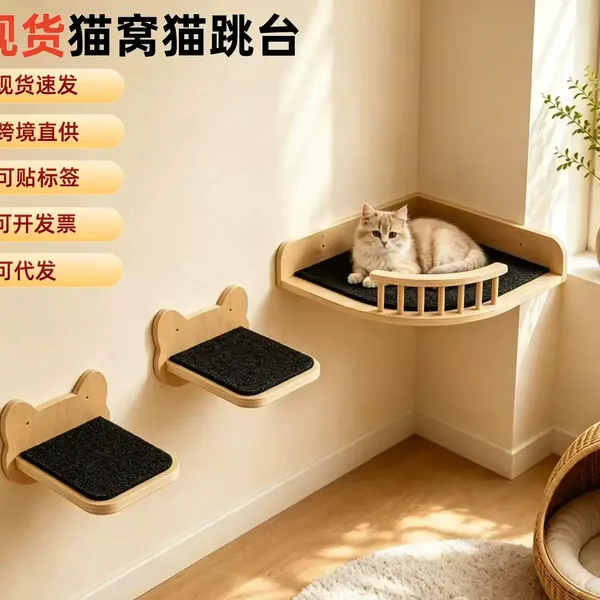
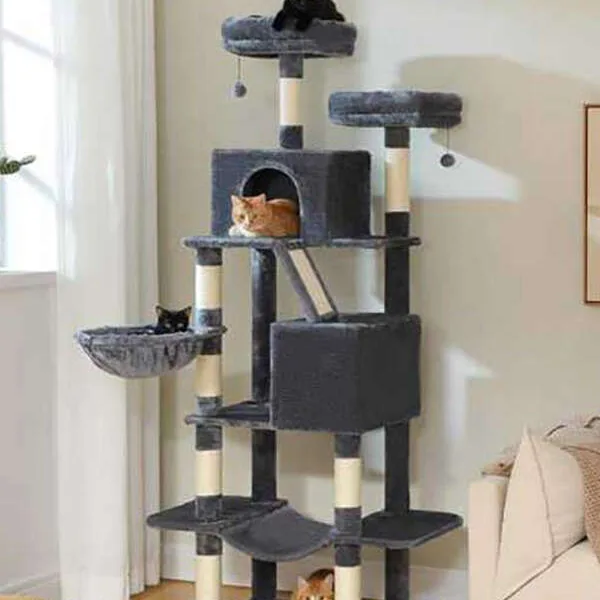
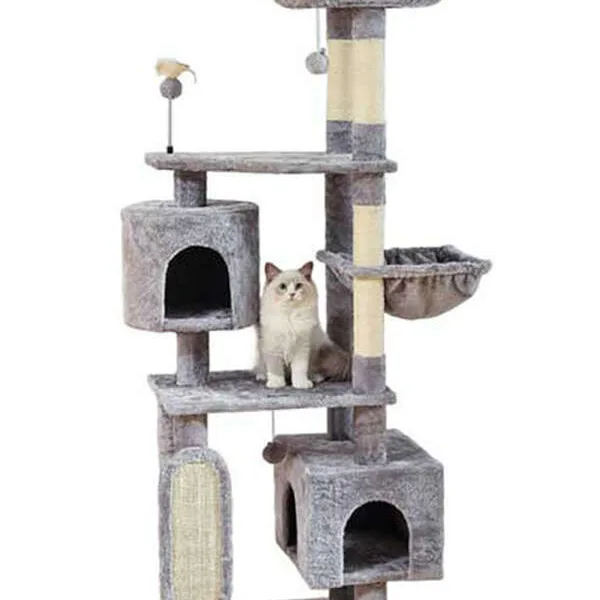
Real products we manufacture — sizes and options are on the product page.
Buying checklist
- Total height and the height of every platform specified
- Riser between platforms at roughly two thirds of kitten shoulder height
- No openings between 40 mm and 110 mm at kitten height
- Base footprint at least one third of total height
- Bottom post wrapped in sisal, not only the top
- Removable cushions washable; toy cords short
FAQ
How tall should a cat tree be for a kitten?
For a kitten under three months, 50–60 cm with two or three platforms is enough and the landing is what matters, not the challenge. A four to five month old can use 70–80 cm comfortably, and by six months a 90–100 cm tree is reasonable if each platform is reachable by a stride from the one below. The mistake to avoid is buying a 150 cm adult tower for a ten-week-old: it climbs to the top on day one and then has no staged way down, which is when shoulder and leg injuries happen. If you want one purchase to last, choose a modular design where sections can be added, or accept that the first tree is a twelve-month product.
Can a kitten use an adult cat tree?
Often yes, with two checks. First, the openings: an adult tree usually has doors and gaps sized for an adult cat, which are simply too large to trap a kitten, so the risk is lower than on a purpose-built kitten tree. Second, the spacing: if the first platform is high off the floor, or platforms are stacked far apart, a young kitten has to jump up and drop down. A bowl or box at the bottom of an adult tree, a temporary step beside it, and supervision for the first week solve most of it. The genuine problem with an adult tree is the height of the descent, not the size of the cat.
Is it worth buying a kitten tree if the cat will outgrow it?
It depends on whether the design can grow with the cat. A tree with a low, wide base and platforms that accept an added upper section stays useful for years; a fixed 50 cm kitten tree does not. In practice the most durable answer for a retailer's range is a 90–100 cm model with a low first platform and a riser that suits a young cat, so it is usable from three months and still correct at two years. The tree that gets returned is the one sold as "kitten size" with no way to extend it, because the buyer works out within six months that the cat sits on the bookshelf instead.
Building a kitten range for your market?
We make cat furniture for retailers and importers: platform heights, risers, base footprints, opening dimensions, sisal placement and carton sizes can all be set per model. Send the age range you are targeting, your market, and how the tree has to be packed, and we will come back with a specification in writing. Where a dimension is outside what we currently run, we will say so rather than quote around it.
See the range